
Abstract
AimExclusion can occur not only in face-to-face communication but also through social communication tools. All kinds of exclusion through media, such as e-mail, phone calls and messages, and social media sites, are defined as cyberostracism. The study aimed to determine the level of cyberostracism (CO) among students who have just started the university, examine variables that are thought to be related, and to evaluate the relationship between cyberostracism and personality types.MethodsThe study covers preparatory and first-year students studying at a total of 209 different universities or colleges in Türkiye. The study group consisted of 2953 students. The CO scale was used to measure the participants’ level of cyberostracism, and the Ten-item Personality Inventory (TIPI) scale was used to measure their personality types.ResultsIn the study, the level of cyberostracism was surprisingly low among young people who had just started university. It was determined that personality types (in univariate analysis) and gender, family type, face-to-face communication with friends of young people and creating memberships with hidden identity on social media were predictive factors for cyberostracism (in multivariate analysis) in those who have just started university.ConclusionIn order to prevent cyberostracism, it may be useful to guide young people to use social media more consciously in the future. It is necessary to increase awareness on this subject by designing new further studies on the subject in larger groups.
Keywords
Introduction
Thanks to the rapid and extraordinary changes in the world of technology, individuals’ access to the internet has increased, and it has become inevitable to meet with the internet.1 The use of mobile phones and the internet has become an indispensable part of daily life for people of all ages and income groups. Mobile phones and the internet provide many conveniences to people’s daily lives in numerous fields, from various learning opportunities to courses, from making friends and entertainment sites to shopping sites.2 The concept of social media, which has entered our lives with technology, is defined as “online platforms that people use to share their ideas, opinions, experiences, perspectives with various messages or images and to communicate with each other,1 However, information technologies, which facilitate daily life to a great extent, bring along some disadvantages, especially for children and young people, in addition to the advantages they provide. At the beginning of these negativities are concepts such as cyberbullying, cyberostracism and isolation from society.3
Exclusion refers to being ignored by one or more people and not being included in a group. Exclusion can occur not only in face-to-face communication but also through social communication tools.3-4 All kinds of exclusion through media, such as e-mail, phone calls and messages, and social media sites, are defined as cyberostracism.5 The effect of cyberostracism on individuals is no less important than exclusion in social environments.6 People’s emotional characteristics may change and deteriorate after exposure to cyberstratification, and they tend to react aggressively.7 Since social media sites, which are communication tools, allow individuals to hide their identities in the virtual environment, it can be assumed that individuals exposed to cyberostracism can somewhat avoid these negative effects.8
Characteristics of personality that are innate and acquired as a result ofexperience and distinguish it from other individuals have been the subject of research in many studies under the title of personality type classification for many years.9-10 Personality type can be considered as one of the factors affecting the reaction and behavior of the individual in challenging situations that may cause psychological stress.11 In addition, it has been suggested that not only the family and social environment but also the individual’s personality traits are effective in controlling negative emotions.12
Our study aimed to determine the level of cyberostracism (CO) among students who have just started university in Türkiye, examine the variables thought to be related, and evaluate the relationship between cyberostracism and personality types.
Materials and Methods
The study is a cross-sectional type of research with data collected between 25.05.21-25.06.2021. The study was approved by the local ethics committee (E-25403353-050.99-194642). The object of the study are preparatory and first-year students studying at a total of 209 different universities or colleges in Türkiye. The questionnaire form, prepared in accordance with the purpose of the study, was transferred online with Google Forms. The researchers reached the participants with the convenience sampling and snowball method. Participation in the study continued for one month, and during this period, 3148 students responded. Of these, 195 students who were found to have duplications or deficiencies in the questionnaires were excluded from the study, and the study group consisted of 2953 students.
A questionnaire form prepared per related literature was used as the data collection tool. The form consisted of three parts. The first part includes some sociodemographic characteristics of the students and some variables that are thought to be related to cyberostracism, the second part consists of questions from the cyberostracism scale, and the third part consists of questions from the Ten-Item Personality Type scale. The students were asked to fill out and forward the questionnaire form to their peers. All the participants have given their written consent before filling the form.
Cyberostracism Scale (CS) was developed by Hatun and Demirci in 2020 to assess the level of cyberostracism. The scale consists of 14 questions in a 5-point Likert type. As the score obtained from the scale increases, the level of cyber exclusion also increases.8
Ten-Item Personality Inventory (TIPI) scale was developed by Gosling et al., it consists of ten items and evaluates five important personality types: openness to experience, conscientiousness, extraversion, agreeableness, and emotional stability.9 Atak carried out the scale’s Turkish validity and reliability study in 2013.13Ethical ApprovalThis study was approved by the Non-Interventional Clinical Research Ethics Committee of Eskişehir Osmangazi University (Date: 2021-05-25, No: E-25403353-050.99-194642)Statistical AnalysisThe data were evaluated in the SPSS (v20.0) statistical package program. The conformity of the data to the normal distribution was evaluated with the Shapiro-Wilk test. The Mann-Whitney U test, the Kruskal-Wallis test and Multiple Linear Regression analysis were used for statistical analysis. p<0.05 was accepted as the statistical significance value.
Results
The study group comprised 1847 (62.5%) female and 1106 (37.5%) male students. Their ages ranged from 17 to 38, with a mean of 19.9±1.8 years. Most students (75.8%) stated that they had a nuclear family structure, and 70.1% stated that their family income was at a medium level. The participants’ scores on the Cyberostracism Scale ranged from 14 to 70, with a mean score of 21.1±8.1 (median: 18).
In the study, 50.4% of the students reported that their friends of the same gender predominated in their group of friends, and 76.6% reported that they had good face-to-face communication with their friends. Of the study group, 35.1% thought their parents were permissive, and 33.7% thought their parents were democratic. In the study, 67.8% of the participants met with smartphones while they were 14 years old or over, and 69.5% preferred spending more than four hours daily with these technological tools. The share of students who stated that they created a membership by hiding their identity on social media was 28.3%, and 85.1% stated that they felt excluded on social media in the last year. The distribution of students’ scores on the Cyberostracism Scale by some socio-demographic characteristics and variables that are believed to be related to cyber ostracism is presented in Table 1. It was determined that 41.8% (n=1233) of the study group had the agreeableness personality type, and 22.2% (n=657) had the conscientiousness personality type. In the conscientiousness group (22.2%), ower levels of cyberostracism were found than in students with other personality types (p<0.001). The distribution of students according to TIPI and their scores on the Cyberostracism Scale by personality types are presented in Table 2.
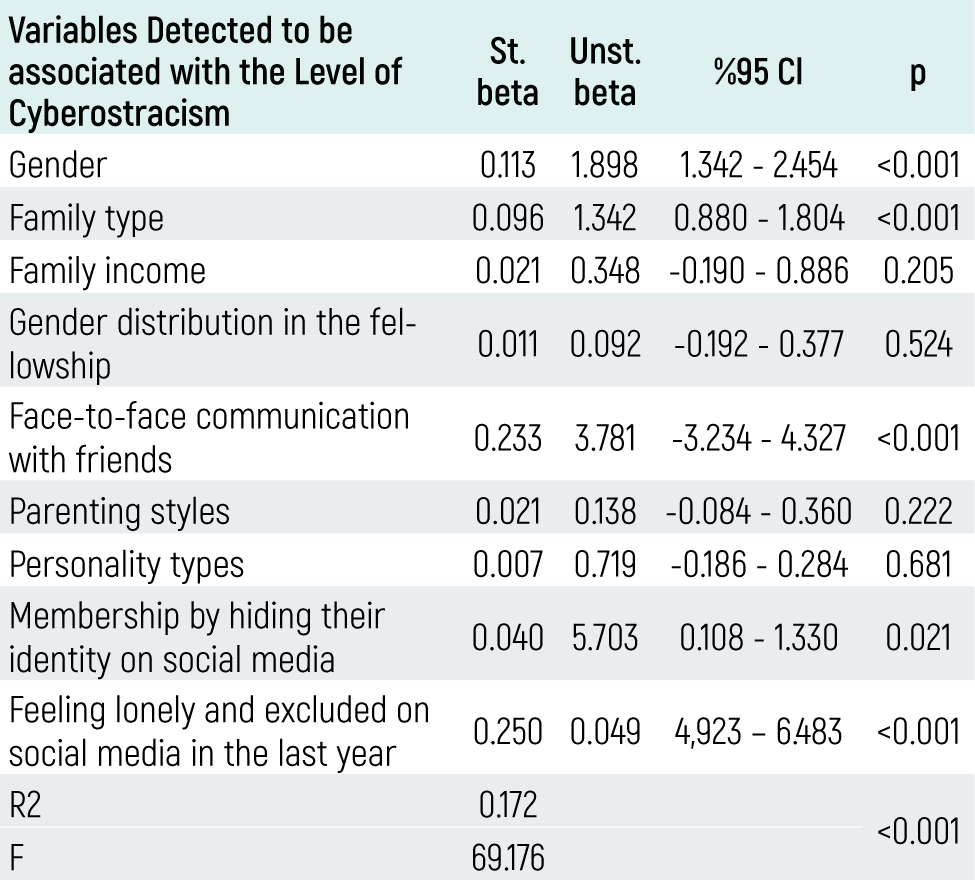
The variables detected to be associated with the level of cyberostracism in the analyzes were gender, family type, family income status, gender distribution in the fellowship, gender distribution of the friend group, face-to-face communication with friends, parenting styles, their personality types, creating a membership with a hidden identity on social media and feeling lonely and excluded on social media recently. The results of the multiple linear regression analysis generated are shown in Table 3.
Discussion
It is estimated that the number of internet users is 4.5 billion, and the number of social media users is more than 3.8 billion in 2020 all over the world (available at: https://datareportal.com/reports/digital-2020-global-digital-overview).https://wearesocial.com/uk/blog/2020/01/digital-2020-3-8-billion-people-use-social-media/ It has been reported that the main purpose of individuals in using social networking sites is to facilitate social relations.14 Today, with the increasing use of the internet and especially with the effect of the COVID-19 pandemic, the restrictive decisions taken, such as the transition of schools to online education and the closing of restaurants and cafes, social relations have shifted more to the cyber environment, and face-to-face relationship opportunities have been limited. This has resulted in young people being forced to change the environment they live in, who have just started university or who have difficulty adapting to face many psychological wars such as cyberbullying, cyber victimization and cyberostracism. The study determined that gender, family type, face-to-face communication with friends and creating memberships with hidden identity on social media were predictive factors for cyberostracism and personality types of young people who have just started university.
Although cyberostracism is a subject that has increased awareness especially in recent years, it is known that young people have frequently faced with cyber bullying and cyberostracism for many years. Although the levels of cyberostracism vary in the literature.8,15-16 it has been shown that the individual is not equally affected by cyberostracism.17 In the study, the level of cyberostracism was surprisingly low among young people who had just started university.
It is known that the young are a particularly susceptible and sensitive group to cyberostracism by their peers.18 Although various findings show that women are more exposed to cyberostracism, the general opinion is that men experience more problems in cybersettings.16 In parallel with this, our study determined that the cyberostracism levels of male students were higher than females. This may be due to the fact that young men play more online video games and spend more time on the internet.
In addition to the type of family in which individuals grow up, many variables, such as the structure and socioeconomic status of the family, and the status of the individual’s intra-family relations, can also affect the behavior of the individual in cybersettings.19 Our study determined that those with a traditional nuclear family and those who described their family income as good had lower cyberostracism levels. Similar results were reported in a study by Oktar et al.15
It is thought that people’s exposure to social ostracism may be related to many different variables, such as their social class, racial characteristics, education level, childhood relationships, living standards and personalitytypes.20 It is clear that personality type and psychological resilience are important factors that determine human behaviors when exposed to difficult life events.12 In our study, young people’s personality types were found to be an important predictor of cyberostracism in univariate analysis. About half of the study group (41.8%) had the agreeableness personality type, while 4.9% had the emotional stability personality type, and the emotional stability personality type had higher cyberostracism levels than the agreeableness personality type. In addition, the conscientiousness group (22.2%) was found to have lower levels of cyberostracism than students with other personality types (p< 0.001). This can be explained by the fact that the psychological methods of coping with stress in difficult conditions are different, and personality is a factor in our behaviors.
It is thought that communication and parental roles in the family contribute significantly to the development of individuals’ personality structures and their human values.21 In the study, students who thought their parents were authoritative and permissive had lower levels of cyberostracism. While authoritarian parents display a very strict disciplinary attitude within the family, negligent parents can push the adolescents away from themselves emotionally and push them to emotional deprivation and loneliness by ignoring their needs without any limitation on the adolescent’s behavior.22 This situation can push adolescents into the wrong circle of friends and cause them to enter dangerous situations and groups that they think can easily be accepted in their real lives, even in face-to-face communication. In parallel, cyberostracism levels were found to be low in those who were good in face-to-face communication and friendship relations, while those who felt lonely and excluded in the past year had higher levels of cyberostracism in this study.
It has been shown that when young people’s friendship requests are accepted on different websites, they are happy and enjoy it, and when their requests are rejected, they have many negative emotions. These negative emotions generally result in antisocial behaviors.23 However, the main purpose of these sites, which were established for socialization purposes, was to enable people to create profiles and connect with other users.24 The study determined that the cyberostracism levels of those who create memberships by hiding their identity on social media were higher. This can be explained by young people’s instinct to escape from cyber victimization and cyberostracism, and encouraging young people to become members of websites by hiding their identities.
Limitations
The fact that the study data were collected by the snowball method due to the pandemic at the time of the study caused the study to include a limited group. In addition, this cross-sectional study could not establish a cause-effect relationship. Another limitation is that the definition of cyberostracism has been made in the last few years, so the information regarding variables related to cyberostracism is limited in the literature.
Conclusion
The study found that the level of cyberostracism was low among university students. Students’ CO levels were higher in those who had negative social media use experiences, such as hiding their identity and feeling lonely on social media. Although personality types were found to be a predictive factor for CO level in univariate analysis, after adjusting confounding factors in multivariate analysis, there was no longer a significant relationship between personality types and CO. Positive or negative situations among young people in social media settings can permanently affect their real lives. In this context, in order to prevent cyberostracism, it may be useful to guide young people to use social media more consciously in the future. It is necessary to increase awareness on the subject by designing new studies on the subject in larger groups and revealing the relationship between cyberostracism and personality types with further studies.
Declarations
Conflict of Interest
None of the authors received any type of financial support that could be considered potential conflict of interest regarding the manuscript or its submission.
Funding
None.
References
- Güney M, Taştepe T. Social media usage and social media addiction in adolescents. J Ank Health Sci. 2020;9(2):183-190.
- Serrano-Cinca C, Muñoz-Soro JF, Brusca I. A multivariate study of internet use and the digital divide. Soc Sci Q. 2018;99(4):1409-1425.
- Allen KA, Ryan T, Gray DL, McInerney DM, Waters L. Social media use and social connectedness in adolescents: the positives and the potential pitfalls. Aust Educ Dev Psychol. 2014;31(1):18-31. doi:10.1017/edp.2014.2
- Williams KD, Nida SA. Ostracism: consequences and coping. Curr Dir Psychol Sci. 2011;20(2):71-75. doi:10.1177/0963721411402480
- Karlen CE, Daniels JR. Cyberostracism and social monitoring: social anxiety’s effects on reactions to exclusion and inclusion online. Illinois: Honors Projects; 2011:147-151.
- Obar JA, Wildman SS. Social media definition and the governance challenge: an introduction to the special issue. Telecomm Policy. 2015;39(9):745-750. doi:10.1016/j.telpol.2015.07.014
- Lansu TAM, van Noorden THJ, Deutz MHF. How children’s victimization relates to distorted versus sensitive social cognition: perception, mood, and need fulfillment in response to cyberball inclusion and exclusion. J Exp Child Psychol. 2017;154:131-145. doi:10.1016/j.jecp.2016.10.012
- Hatun O, Demirci İ. Developing the cyberostracism scale and examining its psychometric characteristics. Int J Ment Health Addict. 2022;20(1):1063-1082.
- Gosling SD, Rentfrow PJ, Swann WB Jr. A very brief measure of the big-five personality domains. J Res Pers. 2003;37(6):504-528. doi:10.1016/s0092-6566(03)00046-1
- Aluja A, Sorrel MA, García LF, García O, Gutierrez F. Factor convergence and predictive analysis of the five factor and alternative five factor personality models with the five-factor personality inventory for ICD-11 (FFiCD). J Pers Disord. 2022;36(3):296-319. doi:10.1521/pedi_2021_35_542
- Shi L, Li H, Huang L, Hou Y, Song L. Does cyberostracism reduce prosocial behaviors? The protective role of psychological resilience. Int J Environ Res Public Health. 2022;19(7):4388. doi:10.3390/ijerph19074388
- Farrukh M, Alzubi Y, Shahzad IA, Waheed A, Kanwal N. Entrepreneurial intentions: the role of personality traits in perspective of theory of planned behaviour. Asia Pac J Innov Entrep. 2018;12(3):399-414. doi:10.1108/apjie-01-2018-0004
- Atak H. The Turkish adaptation of the ten-item personality inventory. Noro Psikiyatr Ars. 2013;50(4):312-319.
- Nadkarni A, Hofmann SG. Why do people use Facebook? Pers Individ Dif. 2012;52(3):243-249. doi:10.1016/j.paid.2011.11.007
- Oktar D, Ünsal A, Arslantas D, Mutlu A, Muz FNÖ. Cyberostracism and self-esteem: a study on medical faculty students in western Turkey. Osmangazi J Med. 2022;44(2):177-185.
- Niu GF, Zhou ZK, Sun X, et al. Cyber-ostracism and its relation to depression among Chinese adolescents: the moderating role of optimism. Pers Individ Dif. 2018;123:105-109. doi:10.1016/j.paid.2017.10.032
- Wang T, Mu W, Li X, Gu X, Duan W. Cyber-ostracism and wellbeing: a moderated mediation model of need satisfaction and psychological stress. Curr Psychol. 2022;41:4931-4941.
- Abrams D, Weick M, Thomas D, Colbe H, Franklin KM. On-line ostracism affects children differently from adolescents and adults. Br J Dev Psychol. 2011;29(1):110-123. doi:10.1348/026151010x494089
- Kılıçer K, Özeke V, Çoklar AN. Investigating social media users’ cyber behaviors from the perspective of human values. Dumlupinar Univ J Soc Sci. 2018;(56):19-39.
- Adaman F, Ardıç OP. Social exclusion in the slum areas of large cities in Turkey. New Perspect Turk. 2008;38:29-60.
- Ikhwan A, Biantoro OF, Rohmad A. The role of the family in internalizing Islamic values. Dinamika Ilmu. 2019;19(2):323-335. doi:10.21093/di.v19i2.1746
- Pinquart M. Associations of parenting styles and dimensions with academic achievement in children and adolescents: a meta-analysis. Educ Psychol Rev. 2016;28:475-493.
- Bevan JL, Pfyl J, Barclay B. Negative emotional and cognitive responses to being unfriended on Facebook: an exploratory study. Comput Human Behav. 2012;28(4):1458-1464. doi:10.1016/j.chb.2012.03.008
- Mike T. Society on the web. In: Dutton WH, ed. The Oxford handbook of internet studies. Oxford University Press; 2013:69.
Tables
Table 1. Distribution of students’ scores on the Cyberostracism Scale by some socio-demographic characteristics and variables thought to be related to cyberostracism.
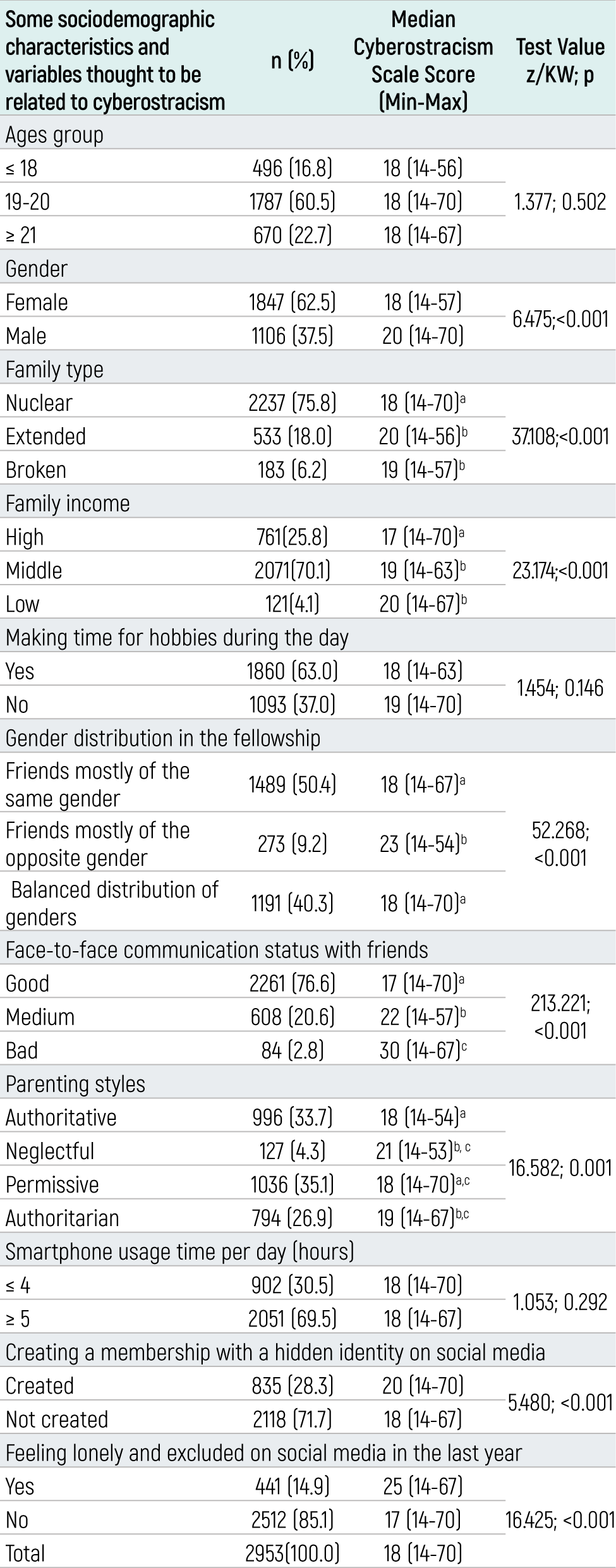
Table 2. Distribution of the students according to TIPI and their scores on the Cyberostracism Scale by personality types.
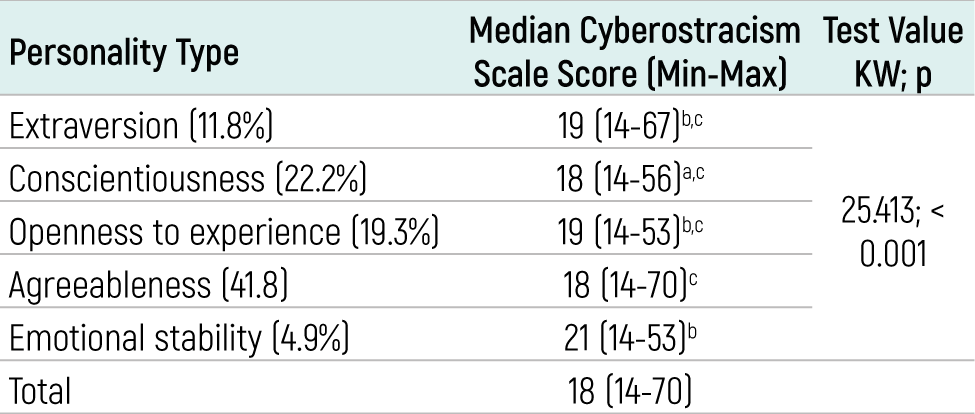
Table 3. Multiple linear regression analysis results (Enter Method) created using variables detected to be associated with the level of cyberostracism.
About This Article
How to Cite This Article
Feyza Nehir Öznur Muz, Ali Kılınç, Alaettin Ünsal, Mustafa Tözün, Didem Arslantaş. Assessment of cyberostracism and personality inventory in first year university students in Türkiye. Eu Clin Anal Med 2026;11(3):42-46. doi:10.4328/ECAM.10053
- Received:
- 21.07.2023
- Accepted:
- 30.08.2023
- Published Online:
- 30.08.2023
- Printed:
- 01.09.2023