
Abstract
AimSoluble CD40 ligand (sCD40L) is a transmembrane protein that leads to endothelial damage and the emergence of vascular diseases. This study was designed to detect the change in serum sCD40L levels in women with PCOS without obvious cardiac pathology.MethodsA total of 60 patients, including 40 PCOS patients without overt heart disease and 20 non PCOS healthy controls, were included in the study. ECG and, if necessary, echocardiography were performed to investigate the presence of cardiac pathologies. The PCOS patients were divided into two subgroups according to their BMI values. Group 1: normal/lean PCOS (n=20), Group 2: overweight PCOS (n=20). Patients with a BMI of 18.5-24.9 kg/m2 were considered normal or underweight. Those with a BMI of 25.0-29.9 kg/m2 were considered obese. sCD40L levels in venous blood samples were measured with ELISA.ResultsThe serum sCD40L values of the obese PCOS group were higher than in both the lean PCOS and the control groups. Lean PCOS group had a higher serum sCD40L value than the control group. The serum LH value in the obese PCOS group was significantly higher than in the patients in both the lean PCOS and control groups.
Serum testosterone levels of the participants in the lean and obese PCOS group were significantly higher than in the control group. The HOMA-IR value in the obese group was significantly higher than in both the lean PCOS and control groups. A positive and significant correlation was found between serum sCD40L, BMI and LH levels in both lean and obese PCOS groups. Similarly, a positive and significant correlation was found between serum testosterone, HOMA-IR and serum sCD40L values in both lean and obese PCOS groups.ConclusionThe significant increase in sCD40L in both lean and obese PCOS patients without obvious cardiovascular disease suggests that it can be used as a marker of endothelial damage.
Keywords
Introduction
Soluble CD40 ligand (sCD40L) is a transmembrane protein that participates in the formation of inflammatory reactions, causes endothelial damage and paves the way for the emergence of vascular diseases. sCD40L is an important member of the tumor necrosis factor family responsible for inflammation. In particular, sCD40L contributes to the development of systemic vascular inflammation by regulating the release of cytokines responsible for inflammation. sCD40L mediates endothelial damage by causing the migration of monocytes and leukocytes to the site of inflammation.1,2 The majority of sCD40L is secreted by activated platelets. Increased serum sCD40L levels have been associated primarily with endothelial damage, followed by atherosclerosis, and ultimately with coronary artery disease and myocardial damage.3,4 Polycystic ovary syndrome (PCOS) is the most frequent endocrine pathology, presented by chronic low-grade inflammation. The syndrome is defined by the presence of at least two criteria for hyperandrogenism: oligo-anovulation and polycystic ovarian morphology. As these criteria are expressed differently in different phenotypes, at least four PCOS phenotypes can be identified. In addition to its acute effects due to subfertility, obesity, androgen elevation and insulin resistance, its longterm sequelae have made PCOS a common disease that requires early diagnosis and treatment.5,6 It is a risk group for PCOS in terms of metabolic syndrome. The increase in metabolic syndrome parameters such as hypertension, dyslipidemia, endothelial dysfunction and vascular thrombosis puts PCOS patients at risk for cardiovascular events.
The rise in serum brain natriuretic peptide levels in PCOS patients with asymptomatic heart disease compared to healthy controls suggests that PCOS accompanies subclinical cardiac pathologies.7 However, a strong serum marker that predicts endothelial damage in PCOS patients followed up with subfertility has not yet been discovered. The fact that sCD40L is a trigger of inflammatory reactions that initiate endothelial damage and atherosclerosis may lead to the emergence of long-term sequelae in PCOS patients. This study was designed to detect the change in serum sCD40L levels in patients with PCOS and no obvious cardiac pathology.
Materials and Methods
A total of 60 patients, including 40 PCOS patients without overt heart disease and 20 non-PCOS healthy controls, were included in the study. Participants were chosen from the patients who consulted at Gözde Akademi Hospital Gynecology outpatient clinic between January 2022 and December 2022. Those who met at least two of the following revised Rotterdam criteria were considered PCOS: (i) hyperandrogenism, (ii) oligo-anovulation and (iii) polycystic ovarian morphology. For the presence of hyperandrogenemia, in addition to the clinical findings of hirsutism, elevated serum testosterone levels were also examined. For the diagnosis of polycystic ovarian morphology, the own of more than 12 follicles between 2-9 mm in ultrasonographic evaluation was sought. The presence of polycystic morphology in one ovary was considered sufficient. Oligo- or amenorrhea condition was sought for ovulatory dysfunction. Patients’ family and medical history was collected in terms of cardiovascular disease. ECG and, if necessary, echocardiography were performed to investigate whether there were cardiac pathologies. PCOS patients were divided into two groups: obese and lean according to their BMI values. BMI values of all patients were obtained by dividing weight in kilograms by height in centimeters (square). The PCOS patients were separated into two subgroups according to their BMI values. Group 1: normal/lean PCOS (n=20), Group 2: overweight PCOS (n=20). Patients with a BMI of 18.5-24.9 kg/m2 were considered normal or underweight. Those with a BMI of 25.0-29.9 kg/ m2 were considered obese.
For the evaluation of basal hormonal and biochemical parameters, venous blood samples were taken on the third day of spontaneous menstrual cycle from patients in the control group and on the third day of progesterone interruption bleeding from anovulatory PCOS patients. Serum luteinizing hormone (LH), follicle-stimulating hormone (FSH), testosterone and fasting insulin levels were calculated. The homeostatic model evaluation [HOMA-IR] formula was used to calculate insulin resistance. Non-PCOS pathologies with hyperandrogenemia and ovulatory dysfunction were not included in the study. Patients with cardiac pathology in clinical and laboratory evaluation were excluded from the study. Those with type 2 diabetes, thyroid and pituitary diseases, androgen-secreting ovarian or adrenal tumors, Cushing’ssyndrome and adrenal hyperplasia were excluded from the study. Those who used insulin sensitizer, hormonal or lipid-lowering drugs, and those who used antiandrogen and oral contraceptives in the last year were excluded from the study.Measurement of serum soluble cluster of differentiation 40 ligand with ELISASoluble cluster of differentiation 40 ligand (sCD40L) levels in venous blood samples were evaluated with the Human sCD40L ELISA kit (Sunred Biotechnology Company, catalog number: 201-12-0252 Shanghai, China) using the quantitative sandwich enzyme immunoassay principle. The main steps of this assay were as follows: frozen serum samples were first dissolved in water at a temperature of 37 °C. Each serum sample was diluted by adding 0.3 mL of a standard material at a dilution ratio of 1:100. One well was left empty. Chromogenic solution was added to the wells to allow the reaction to take place. The absorbances of the samples studied in accordance with the kit procedure were measured in a Bio-Tek ELx800 (BioTek Instruments, USA) device at a wavelength of 450 nanometers. Concentrations corresponding to all absorbances were calculated in ng/mL with the formula obtained with the help of the standard curve graph. The measurement range of the kit was 0.1–30 ng/mL, and the minimum measurable value was 0.075 ng/mL. The intra-Assay CV value of the kit was <10%, while the inter-Assay CV value was <12%.Ethical ApprovalEthics Committee approval for the study was obtained. This study was approved by the Ethics Committee of Tinaztepe University (Date: 2022, Decision No: 03)Statistical AnalysisAnalysis of serum sCD40L and other laboratory and demographic data was performed with the SPSS 21 program (SPSS Inc., Chicago, IL,USA). The Shapiro-Wilk test was used to determine data distribution patterns. Differences in the demographic and clinical findings of both groups were evaluated by t test or the Mann-Whitney U test according to whether the variables were categorical or not. The correlations between serum sCD40L and demographic, and laboratory parameters were analyzed using Pearson’s correlation analysisi. Results were presented as mean ± SD or as the number of cases or percentage. All comparisons with p<0.05 were considered significant.Reporting GuidelinesThe study was reported in accordance with STROBE guidelines.
Results
Demographic and laboratory characteristics of the lean and obese PCOS groups as well as the control group are presentated in Table 1. There was no difference between the mean ages of all three groups. The BMI values in the obese PCOS group were higher than in both the lean PCOS group and the control group. The BMI values of the Lean PCOS group and the control group were the same. The serum LH value in the obese PCOS group was significantly higher than in the patients in both the lean PCOS and control groups. The LH value in the Lean PCOS group was also significantly higher than in the control group. Serum FSH levels of the lean and obese PCOS and control groups were similar. The serum testosterone levels of the participants in the lean and obese PCOS group were significantly higher than in the control group. There was no significant difference between the PCOS groups in terms of androgen levels. The HOMA-IR value in the obese group was significantly higher than in both the lean PCOS and control groups. The HOMA-IR value in lean PCOS patients was significantly higher than in the control group. The serum sCD40L value in the obese group was higher than in both the lean PCOS group and the control group. Lean PCOS group had higher serum sCD40L value than controls.
Pearson’s correlation analysis results of PCOS groups are presented in Table 2. There was no significant relationship between age and serum scD40L levels in the lean and obese PCOS groups. A positive and significant correlation was established between serum sCD40L levels, BMI and serum LH levels in both lean PCOS and obese PCOS groups. Similarly, a positive and significant correlation was established between serum testosterone levels and serum sCD40L levels in both lean and obese PCOS groups. A positive and significant correlation was established between HOMA-IR values and serum sCD40L levels in both PCOS groups.
Discussion
PCOS is an endocrine pathology with multifactorial and polyenic etiology that includes diabetes mellitus, endometrial carcinoma and cardiovascular events as a long-term sequelae.5,7 Insulin resistance, hyperandrogenemia, chronic inflammation and hyperlipidemia, which are the main components of PCOS, trigger endothelial damage, putting PCOS patients in the risk group for cardiovascular diseases.8,9 sCD40L from platelets mediates thrombotic and inflammatory processes, contributing to inflammation associated with increased cardiovascular disease risk.10 However, we do not know exactly which PCOS patient will develop endothelial damage, atherosclerosis and subsequent cardiovascular disease. Phenotypic variables play a critical role in the formation of adverse effects related to PCOS. In this context, it is obvious that androgen elevation, polycystic ovarian morphology and ovulatory dysfunction contribute to the formation of long-term complications of PCOS.11 The presence of high androgens increases the susceptibility to endothelial damage, similar to men, and paves the way for the emergence of cardiac and cerebro-vascular diseases. Apart from phenotypic variables, BMI of PCOS patient contributes to the development of cardiovascular disease. Most PCOS patients, regardless of their phenotype, are obese or overweight and have a high BMI.12 The presence of a high BMI is an evidence that the individual is more exposed to the adverse metabolic effects of PCOS.5 On the other hand, in lean phenotypes, the metabolic effects of the syndrome show a milder course.5 Sometimes, a PCOS patient with an obese phenotype can turn into a lean form and a different phenotype with life style changes. This is the initial clinical search designed to examine the levels of sCD40L, an inflammatory marker of endothelial damage, in lean and obese PCOS patients without obvious cardiac pathology. sCD40L showed a significant increase in obese PCOS patients checked to lean PCOS and healthy controls. This finding is important in terms of showing that PCOS alone causes endothelial damage. Higher serum sCD40L levels in the case of high BMI are further evidence that obesity makes an extra contribution to endothelial damage in addition to PCOS.In the correlation analysis we conducted to investigate the effect of BMI on sCD40L production in lean and obese PCOS patients, we found that BMI values have a significant effect on sCD40L production. There was a positive and significant correlation between BMI and sCD40L in both lean and obese PCOS patients. The correlation between sCD40L and BMI was more pronounced in the obese group. These findings are important evidence that obese PCOS cases are more exposed to the adverse metabolic effects of the syndrome. Significantly increased levels of sCD40L in obese PCOS patients support that endothelial damage is more pronounced than in the lean PCOS group. However, the markedly higher sCD40L levels in lean PCOS patients compared to controls suggest that PCOS causes endothelial damage independent of BMI. The increase in sCD40L levels in both BMI groups may be evidence of very early onset of endothelial damage in PCOS patients without overt cardiovascular disease.
Insulin resistance is the most blamed mechanism in the development of cardiovascular disease related to PCOS. The presence of metabolic syndrome components such as dyslipidemia, hypertension and diabetes also contributes to the improvement of vascular disease.13 The presence of a positive and significant correlation between sCD40L and HOMA-IR in both the obese and lean PCOS groups is a finding that supports the role of insulin resistance in the occurrence of endothelial damage. The stronger correlation between sCD40L and HOMA-IR in the obese group may be due to the inducing effect of obesity on the development of insulin resistance. On the other hand, the positive and significant correlation between serum testosterone levels and sCD40L in lean and obese PCOS patients supports the fact that factors other than insulin resistance play a role in the formation of endothelial damage. The frequent occurrence of cardiovascular disease and other long-term sequelae in PCOS patients with metabolic syndrome components supports this idea.12,13 The more significant increase in cardiovascular risk parameters in hyperandrogenic women with PCOS suggests that androgens also predispose to endothelial damage. The higher risk of coronary artery disease in men is a finding that supports the endothelial damaging effect of androgen elevation.12 In the asset of high androgen, an increase in at least one of the endothelial damage markers such as C-reactive protein, homocysteine or D-dimer suggests that metabolic syndrome parameters and androgens act together in the development of cardiovascular disease.14
Many parameters such as coronary artery calcification, increase in D-dimer or C-reactive protein, increase in carotid intima-media thickness have been used as subclinical cardiovascular disease markers in PCOS patients.11 However, no marker was found to be specific to PCOS. The significant increase in sCD40L in both lean and obese PCOS patients without obvious cardiovascular disease suggests that it can be used as a marker of endothelial damage. Comprehensive predictive studies investigating serum sCD40L levels according to PCOS phenotypes are required to reach a clearer conclusion.
Limitations
The main limitations of this study are its single-center design, relatively small sample size, and cross-sectional nature, which preclude causal inferences. Larger prospective studies are needed to validate these findings.
Conclusion
Serum sCD40L levels were significantly elevated in both lean and obese women with PCOS and were associated with BMI, HOMA-IR, LH, and testosterone levels. These findings suggest that sCD40L may serve as a potential marker of endothelial damage in women with PCOS before overt cardiovascular disease develops.
Declarations
Ethics Declarations
The authors declare that all procedures performed in this study were conducted in accordance with institutional, national, and international ethical standards.
Animal and Human Rights Statement
All procedures performed in this study involving human participants were conducted in accordance with the ethical standards of the institutional and national research committee and with the Declaration of Helsinki and its later amendments.
Informed Consent
Written informed consent was obtained from all participants.
Data Availability
The data supporting the findings of this study are available from the corresponding author upon reasonable request.
Conflict of Interest
The authors declare no conflict of interest.
Funding
None.
Author Contributions (CRediT Taxonomy)
Conceptualization: Z.K.; F.T.Ç.
Methodology: Z.K.; F.T.Ç.
Investigation: Z.K.
Data Curation: Z.K.
Formal Analysis: Z.K.
Writing – original draft: Z.K.
Writing – review & editing: F.T.Ç.
Supervision: F.T.Ç.
AI Usage Disclosure
No artificial intelligence tools were used in the preparation of this manuscript.
Abbreviations
BMI: Body mass index
ECG: Electrocardiography
ELISA: Enzyme-linked immunosorbent assay
FSH: Follicle-stimulating hormone
HOMA-IR: Homeostatic model assessment of insulin resistance
LH: Luteinizing hormone
PCOS: Polycystic ovary syndrome
sCD40L: Soluble CD40 ligand
SPSS: Statistical Package for the Social Sciences
References
- Hassan GS, Merhi Y, Mourad WM. CD154 and its receptors in inflammatory vascular pathologies. Trends Immunol. 2009;30(4):165-172. doi:10.1016/j.it.2009.01.004
- Thienel U, Loike J, Yellin MJ. CD154 (CD40L) induces human endothelial cell chemokine production and migration of leukocyte subsets. Cell Immunol. 1999;198(2):87-95. doi:10.1006/cimm.1999.1583
- Aukrust P, Muller F, Ueland T, et al. Enhanced levels of soluble and membrane-bound CD40 ligand in patients with unstable angina: possible reflection of T lymphocyte and platelet involvement in the pathogenesis of acute coronary syndromes. Circulation. 1999;100(6):614-620. doi:10.1161/01.cir.100.6.614
- Ueland T, Aukrust P, Yndestad A, et al. Soluble CD40 ligand in acute and chronic heart failure. Eur Heart J. 2005;26(11):1101-1107. doi:10.1093/eurheartj/ehi132
- Azziz R. Polycystic ovary syndrome. Obstet Gynecol. 2018;132(2):321-336. doi:10.1097/aog.0000000000002698
- Anagnostis P, Tarlatzis BC, Kauffman RP. Polycystic ovarian syndrome (PCOS): long-term metabolic consequences. Metabolism. 2018;86:33-43. doi:10.1016/j.metabol.2017.09.016
- Rudnicka E, Kunicki M, Suchta K, et al. Inflammatory markers in women with polycystic ovary syndrome. Biomed Res Int. 2020;2020:4092470. doi:10.1155/2020/4092470
- Celik O, Sahin I, Celik N, et al. Diagnostic potential of serum N-terminal pro-B-type brain natriuretic peptide level in detection of cardiac wall stress in women with polycystic ovary syndrome: a cross-sectional comparison study. Hum Reprod. 2007;22(11):2992-2998. doi:10.1093/humrep/dem286
- Carmina E, Lobo RA. Comparing lean and obese PCOS in different PCOS phenotypes: evidence that body weight is more important than the Rotterdam phenotype in influencing metabolic status. Diagnostics (Basel). 2022;12(10):2313. doi:10.3390/diagnostics12102313
- Portier I, Campbell RA. Role of platelets in detection and regulation of infection. Arterioscler Thromb Vasc Biol. 2021;41(1):70-78. doi:10.1161/atvbaha.120.314645
- Dietz de Loos ALP, Jiskoot G, Timman R, et al. Improvements in PCOS characteristics and phenotype severity during a randomized controlled lifestyle intervention. Reprod Biomed Online. 2021;43(2):298-309. doi:10.1016/j.rbmo.2021.05.008
- Carmina E, Longo RA, Rini GB, Lobo RA. Phenotypic variation in hyperandrogenic women influences the finding of abnormal metabolic and cardiovascular risk parameters. J Clin Endocrinol Metab. 2005;90(5):2545-2549. doi:10.1210/jc.2004-2279
- Osibogun O, Ogunmoroti O, Michos ED. Polycystic ovary syndrome and cardiometabolic risk: opportunities for cardiovascular disease prevention. Trends Cardiovasc Med. 2020;30(7):399-404. doi:10.1016/j.tcm.2019.08.010
- Quarck R, Nawrot T, Meyns B, Delcroix M. C-reactive protein: a new predictor of adverse outcome in pulmonary arterial hypertension. J Am Coll Cardiol. 2009; 53(14):1211-8.
Tables
Table 1. Demographic and clinical parameters of the PCOS and control groups
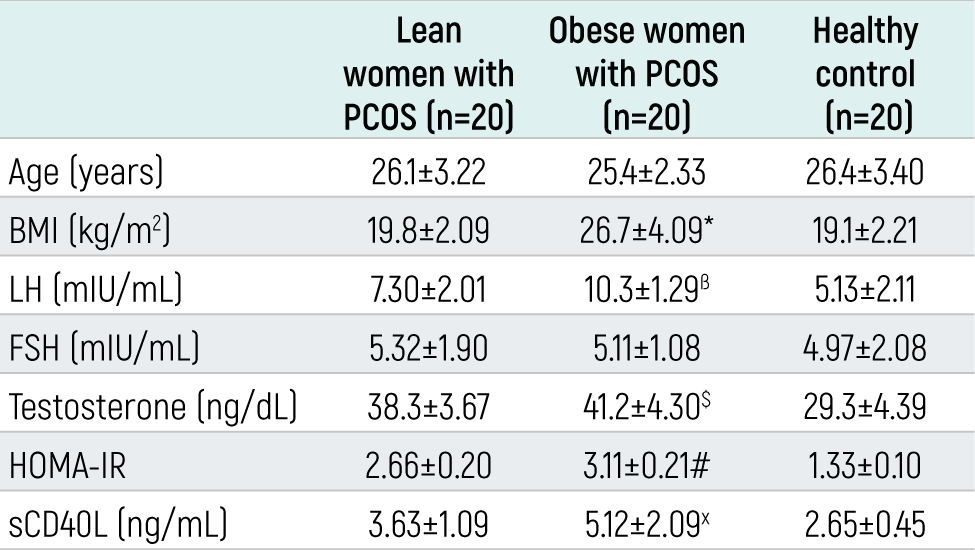
*: Statistically significant compared to both groups (p
Table 2. Correlations of serum sCD40L, demographic and laboratory parameters
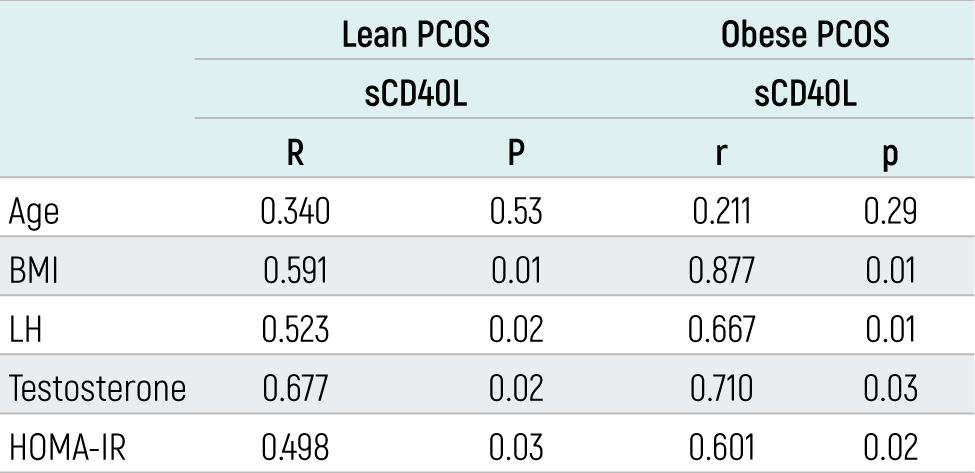
BMI: body mass index, HOMA-IR: assessment of insulin resistance, LH: luteinizing hormone
Additional Information
Publisher’s Note
Bayrakol MP remains neutral with regard to jurisdictional and institutional claims.
Rights and Permissions

This work is licensed under a Creative Commons Attribution-NonCommercial 4.0 International License (CC BY-NC 4.0). To view a copy of the license, visit https://creativecommons.org/licenses/by-nc/4.0/
About This Article
How to Cite This Article
Zercan Kalı, Fatma Tanılır Çağıra. Soluble CD40 ligand (sCD40L) may be a predictive marker of vascular endothelial damage in lean and obese women with PCOS. Eu Clin Anal Med 2026;11(3):47-50. doi:10.4328/ECAM.10054
- Received:
- 11.08.2023
- Accepted:
- 30.08.2023
- Published Online:
- 31.08.2023
- Printed:
- 01.09.2023