
Abstract
AimVitamin D levels influence the risk of fracture, rickets, osteomalacia, and osteoporosis. Vitamin D protects the body against muscle weakness, helps regulate the heartbeat, strengthens the immune system and thyroid function, and is necessary for normal blood clotting. Vitamin D increases calcium absorption from the digestive tract, helps the accumulation of calcium in the bones and also accelerates the active transport of calcium. Humans obtain vitamin D from exposure to sunlight and from diet.MethodsThe patients admitted to Suleyman Demirel University Faculty of Medicine Research and Application Hospital during a one-year period were examined to determine 25 OH vitamin D levels. 12,920 male and female patients were included in the study. Statistical analysis was performed with SPSS.ResultsThere was a significant difference between 25 OH vitamin D levels of patients in the winter season and the spring and summer seasons (<0.05). 25 OH vitamin D levels of men were significantly higher than those of women (<0.05). 25 OH vitamin D levels were low in 72.48% of all patients (<20 ng/ml). The ratio of 25 OH vitamin D levels less than 10 ng/ml was found in 40.92% of the patients.ConclusionWhen assessing 25 OH vitamin D levels, the season of the year and sex of the patients should be taken into consideration.
Keywords
Introduction
D vitamins play an important role in the bone metabolism and calcium and phosphorus regulation of the human body. Vitamin D levels influence the risk of fractures, rickets, osteomalacia, and osteoporosis. Vitamin D protects the body against muscle weakness. It helps regulate the heartbeat, strengthens the immune system and the thyroid function, and is necessary for normal blood clotting. Vitamin D increases calcium absorption from the digestive tract, helps the accumulation of calcium in the bones, and accelerates the active transport of calcium. Humans obtain vitamin D from exposure to sunlight and from their diet.1-2 Vitamin D deficiency has become a more common problem due to low sunlight intake due to indoor area life, clothing style, use of high-factor cream to prevent harmful effects of the sun, and seasonal changes.3 Despite there being a lot of research on the lack of vitamin D and seasonal distribution in the literature, there had been no research done in the province of Isparta. This study will investigate the incidence and seasonal distribution of vitamin D deficiency in patients admitted to the SDU Medical Faculty Hospital in Isparta within a oneyear period. In this study, a possible relationship between vitamin D deficiency and seasonal distribution was shown in these patients and the groundwork for new studies and research on this topic was prepared.
Materials and Methods
The present study was conducted upon the approval of Suleyman Demirel University, Medical Faculty, Head of Clinical Research Ethical Committee.
During a one-year period, patients were evaluated for 25 OH vitamin D levels. 12,920 patients were included in the study, 4,019 males and 8,901 females.
The SPSS package program was used for the statistical analysis. The significance limit was accepted as p<0.05.
Results
There was a significant difference in 25 OH vitamin D levels between patients in the winter season when compared with the spring and summer seasons (p<0.05). The 25 OH vitamin D levels of men were significantly higher than the levels of the women (p<0.05). 25 OH vitamin D levels were found low in 72.48% of all patients (<20 ng/ml). The ratio of 25 OH vitamin D levels was less than 10 ng/ml in 40.92% of the patients. All results are shown in Table 1-5.
Discussion
Vitamin D is one of the most important hormones for growth, development, and healthy skeletal structure throughout life. Plants and animals exposed to sunlight have the ability to synthesize vitamin D. Vitamin D is synthesized directly under the influence of sunlight.3-4 When assessing 25 OH vitamin D levels, the season of the year and the sex of patients should be taken into consideration. Vitamin D levels may also differ according to the measurement method. It is necessary to compare levels with measurements made by a similar method.5 In studies similar to ours, the regional differences are an important factor in the incidence of vitamin D deficiency.6 Today, vitamin D deficiency is accepted as a worldwide epidemic.7 The demand for 25-OH D testing, and thus the cost of testing, is increasing all over the world yearly.8 For this reason, the diagnosis of vitamin D deficiency should be made correctly. A condition that seems to be a limitation of our research is that patients who are included in the study are not aware of whether they have taken vitamin D supplementation. However, the expected low level of 25-OH D levels in all patients suggests that most patients do not receive vitamin D supplementation. The number of patients in our research is adequate and in accord with the majority of similar investigations.6,9 As a result of this study, when assessing 25 OH vitamin D levels, the season of the year and the sex of the patients should be taken into consideration.EthicalThe present study was conducted upon the approval of Süleyman Demirel University, Medical Faculty, Head of Clinical Research Ethical Committee.RemarksThe present study was submitted as a poster during the XXIV International Symposium on Morphological Sciences (ISMS) held in Istanbul, Turkey, September 2-6, 2015. An abstract of the poster was published in a special issue of Anatomy Journal in 2015.
Declarations
Informed Consent
Informed consent was waived due to the retrospective design of the study.
Conflict of Interest
None of the authors received any type of financial support that could be considered potential conflict of interest regarding the manuscript or its submission.
Funding
None.
References
- Holick MF. Vitamin D deficiency. N Engl J Med. 2007;357(3):266-281. doi:10.1056/nejmra070553
- Lieben L, Carmeliet G, Masuyama R. Calcemic actions of vitamin D: effects on the intestine, kidney and bone. Best Pract Res Clin Endocrinol Metab. 2011;25(4):561-572. doi:10.1016/j.beem.2011.05.008
- Holick MF, Chen TC. Vitamin D deficiency: a worldwide problem with health consequences. Am J Clin Nutr. 2008;87(4):1080-1086. doi:10.1093/ajcn/87.4.1080s
- Holick MF. Vitamin D: a millennium perspective. J Cell Biochem. 2003;88(2):296-307. doi:10.1002/jcb.10338
- Chen H, McCoy LF, Schleicher RL, Pfeiffer CM. Measurement of 25(OH)D3 and 25(OH)D2 in human serum using liquid chromatography-tandem mass spectrometry and its comparison with a radioimmunoassay method. Clin Chim Acta. 2008;391(1-2):6-12. doi:10.1016/j.cca.2008.01.017
- Öğüş E, Sürer H, Kılınç AŞ, Fidancı V, Yılmaz G, Dindar N, et al. D vitamini düzeylerinin aylara, cinsiyete ve yaşa göre değerlendirilmesi. Ankara Med J. 2015;15(1):1-5. doi:10.17098/amj.88875
- Zipitis CS, Akobeng AK. Vitamin D supplementation in early childhood and risk of type 1 diabetes: a systematic review and meta-analysis. Arch Dis Child. 2008;93:512-517. doi:10.1136/adc.2007.128579
- Zhao S, Gardner K, Taylor W, Marks E, Goodson N. Vitamin D assessment in primary care: changing patterns of testing. London J Prim Care (Abingdon). 2015;7(2):15-22. doi:10.1080/17571472.2015.11493430
- Vurgun E, Evliyaoğlu O, Yıldırmak S. Kanıta dayalı laboratuvar: D vitamini yetersizlik sınırlarının belirlenmesi. Med Bull Haseki. 2016;54(2).
Tables
Table 1. Sex * Vitamin D levels groups cross tabulation vita

Table 2. Seasons * vitamin D levels groups cross tabulation

Table 3. Comparison of sex and vitamin D levels

Table 4. Comparison of season and vitamin D levels descriptives vitamin D
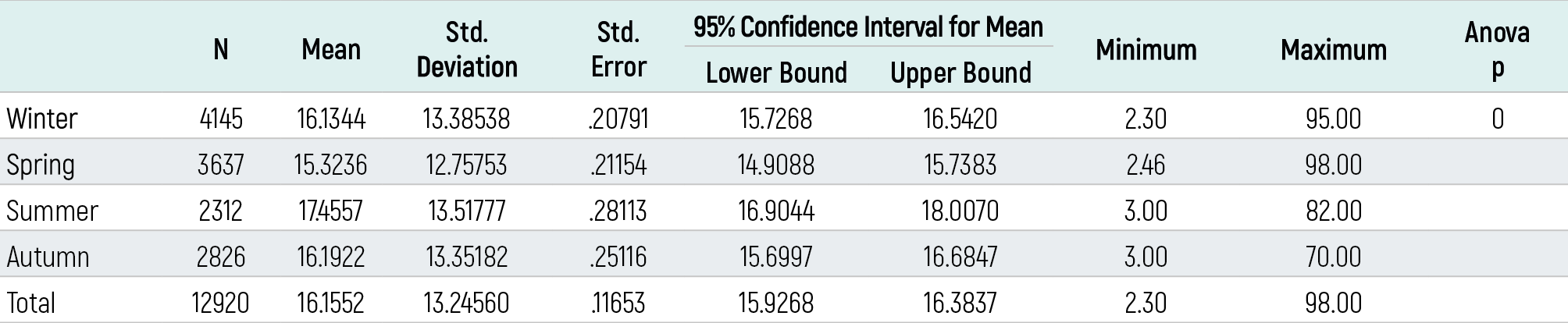
Table 5. Season and vitamin D levels comparison post hoc tests
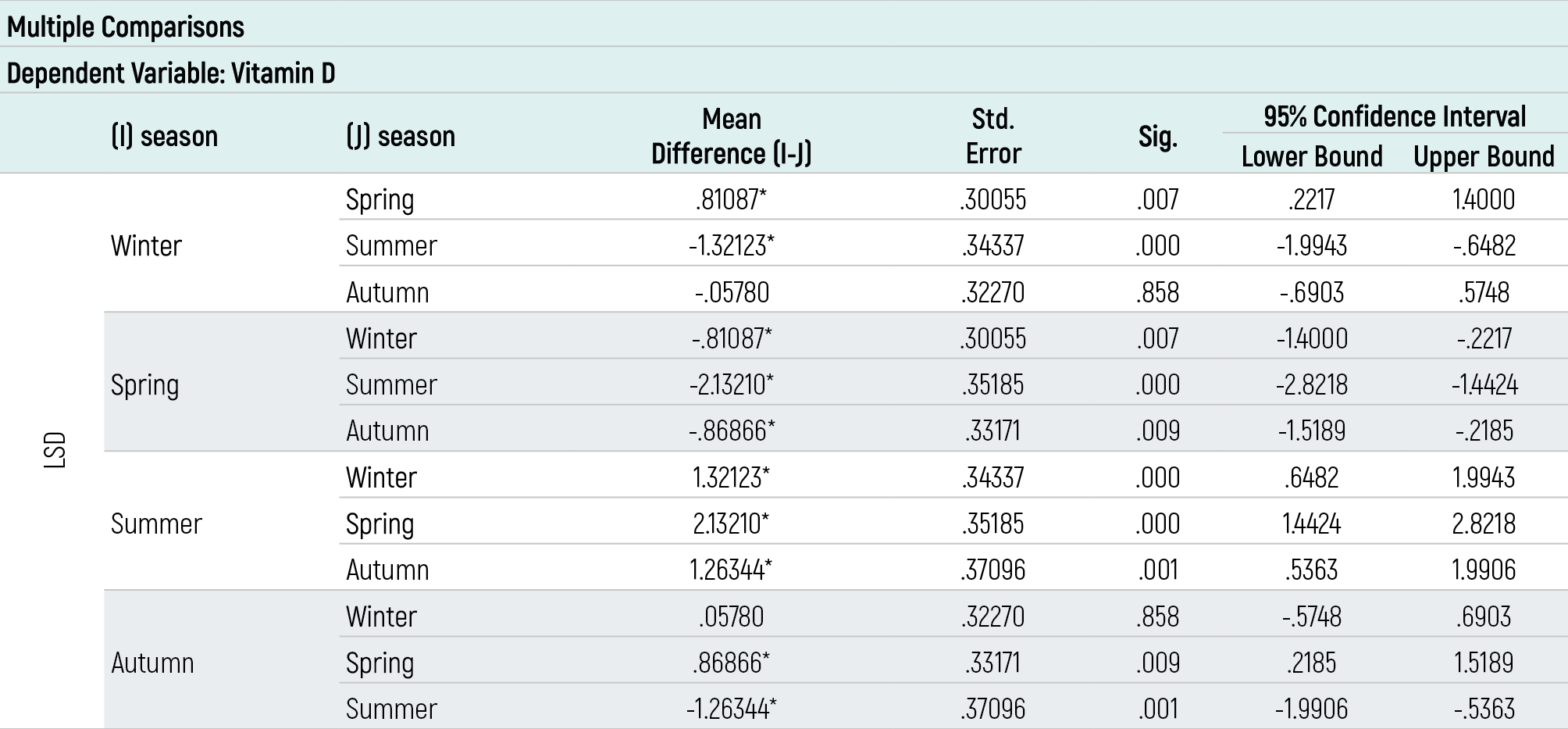
Additional Information
Publisher’s Note
Bayrakol MP remains neutral with regard to jurisdictional and institutional claims.
Rights and Permissions

This work is licensed under a Creative Commons Attribution-NonCommercial 4.0 International License (CC BY-NC 4.0). To view a copy of the license, visit https://creativecommons.org/licenses/by-nc/4.0/
About This Article
How to Cite This Article
Hasan Basri Savaş, Betul Mermı Ceyhan, Fatih Gultekin. 25 OH vitamin D levels of patients living in Isparta, Türkiye. Eu Clin Anal Med 2026;5(2):21-23. doi:10.4328/ECAM.107
- Received:
- 27.02.2017
- Accepted:
- 14.03.2017
- Published Online:
- 01.05.2017
- Printed:
- 01.05.2017