
Abstract
IntroductionWe report the case of a 45-year-old female who was referred to our clinic with dyspnea and palpitation.Case PresentationWe learned from the patient history that she had sustained a car accident 15 years ago. Transthoracic echocardiography revealed rupture of the anterior tricuspid leaflet and prolapse of the mitral valve, causing severe tricuspid and moderate mitral valve regurgitation.
The mitral valve was repaired with artificial chordae replacement and ring annuloplasty. The tricuspid valve was also repaired with anterior tricuspid leaflet triangular plication and ring annuloplasty after artificial chordae implantation. The longitudinal right atrial incision was sutured vertically, and the right atrium size was reduced with plication.ConclusionFirst and sixth-month echocardiographic follow-ups showed trivial tricuspid insufficiency without any complaints.
Keywords
Introduction
Posttraumatic tricuspid insufficiency (TI) due to rupture of the chordal structure of the tricuspid valve (TV) is a very rare entity and mostly caused by blunt chest trauma. Clinical symptoms are generally mild and the hemodynamic consequences are often well-tolerated, so most of the cases have been diagnosed and treated several years after initial trauma.1
Posttraumatic TI can be caused by several reasons such as annular detachment of leaflets, anterior leaflet chordae rupture and papillary muscle rupture.2-4
Here we present the surgical repair of tricuspid and mitral valve regurgitation which was caused by blunt chest trauma 15 years ago.
Discussion
Blunt chest-wall trauma is common during traffic accidents. Traumatic cardiac injuries include myocardial contusion, pericardial effusion, injuries of great vessels or coronary arteries and valvular disruptions. Among valvular injuries, the aortic valve is the most frequently affected valve.2,5-6
A sudden antero-posterior compression generates a severe tension and a regurgitant jet that can result in the rupture of papillary muscle and/or chordae tendinae, especially during the end-diastolic phase. Furthermore, valvular disruption can occur over time because of inflammation, necrosis or contusion of the papillary muscles or chordae tendineae.1,7
There is an ongoing debate in the use of echocardiography as a screening tool in patients who are suffering from blunt chest wall trauma. Furthermore, both TTE and transesophageal echocardiography (TEE) have their limitations, though the diagnostic value of TEE is 56% and upon TTE, the yield is lower.6 We suggest repeat examinations or the application of other imaging methods if clinical suspicion exists.
Traumatic TI is a very rare condition but the true frequency of this disease is probably underestimated because of a possible long asymptomatic phase.8-9 Patients become symptomatic following dilatation of right cardiac chambers and the annular dilatation. Mitral valve involvement contributes to the progressive dilatation resulting in right ventricular failure.
Functional TI is more amenable for repair to preserve the right ventricular function. Right atrial dilatation over 8 cm and right ventricular dilatation over 5.5 cm is a challenging situation. However, tricuspid valve repair is superior with lower mortality and freedom from reoperation rates.10-11
Precise measurement of artificial chordae length and adequate plication of the leaflet without reducing the valve area and increasing the coaptation zone were the key pitfalls in this successful repair. Short-term results show this method can be used even in delayed cases of posttraumatic TI with ventricular and atrial dilatation.
Declarations
Animal and Human Rights Statement
All procedures performed in this study were in accordance with the ethical standards of the institutional and/or national research committee and with the 1964 Helsinki Declaration and its later amendments.
Informed Consent
Informed consent was obtained from all participants.
Conflict of Interest
The authors declare no conflicts of interest.
Funding
None.
References
- Bortolotti U, Scioti G, Milano A, Guglielmi C, Benedetti M, Tartarini G, et al. Post-traumatic tricuspid valve insufficiency: 2 cases of delayed clinical manifestation. Tex Heart Inst J. 1997;24(3):223-225.
- Correia PM, Coutinho GF, Antunes MJ. Severe tricuspid regurgitation after traumatic papillary muscle rupture. Eur J Cardiothorac Surg. 2012;41(5):128. doi:10.1093/ejcts/ezs095
- Lin SJ, Chen CW, Chou CJ, Liu KT, Su HM, Lin TH, et al. Traumatic tricuspid insufficiency with chordae tendinae rupture: a case report and literature review. Kaohsiung J Med Sci. 2006;22(12):626-629. doi:10.1016/s1607-551x(09)70363-8
- Mehrotra D, Dalley P, Mahon B. Tricuspid valve avulsion after blunt chest trauma. Tex Heart Inst J. 2012;39(5):668-670.
- Bernabeu E, Mestres CA, Lama-Osorio P, Josa M. Acute aortic and mitral valve regurgitation following blunt chest trauma. Interact Cardiovasc Thorac Surg. 2004;3(1):198-200. doi:10.1016/s1569-9293(03)00267-6
- Ismailov RM, Weiss HB, Ness RB, Lawrence BA, Miller TR. Blunt cardiac injury associated with cardiac valve insufficiency: trauma links to chronic disease? Injury. 2005;36(9):1022-1028. doi:10.1016/j.injury.2005.05.028
- Kulik A, Al-Saigh M, Yelle JD, Rubens FD. Subacute tricuspid valve rupture after traumatic cardiac and pulmonary contusions. Ann Thorac Surg. 2006;81(3):1111-1112. doi:10.1016/j.athoracsur.2004.12.027
- Emmert MY, Pretre R, Suendermann S, Weber B, Bettex DA, Hoerstrup SP, et al. Severe traumatic tricuspid insufficiency detected 10 years after blunt chest trauma. Clin Res Cardiol. 2011;100(2):177-179. doi:10.1007/s00392-010-0219-6
- Furukawa N, Hakim-Meibodi K, Gummert J. Isolated latent tricuspid regurgitation caused by blunt trauma. Thorac Cardiovasc Surg. 2011;59(8):497-499. doi:10.1055/s-0030-1250723
- Said SM, Burkhart HM, Schaff HV, Johnson JN, Connolly HM, Dearani JA. When should a mechanical tricuspid valve replacement be considered? J Thorac Cardiovasc Surg. 2014;148(2):603-608. doi:10.1016/j.jtcvs.2013.09.043
- Mestres CA, Fita G, Parra VM, Pomar JL, Bernal JM. Tricuspid valve surgery. HSR Proc Intensive Care Cardiovasc Anesth. 2012;4(4):261-267.
- Cagli K. A simple method of making artificial chordal loops for mitral valve repair. Ann Thorac Surg. 2010. doi:10.1016/j.athoracsur.2009.11.055
Figures
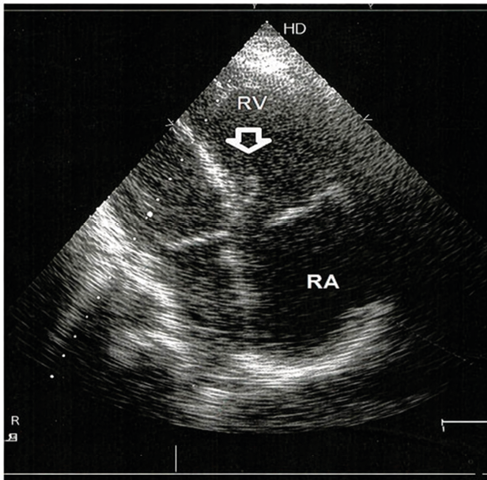
Figure 1. Tricuspid valve, flail anterior leaflet (arrow). (RA right atrium, RV right ventricle)
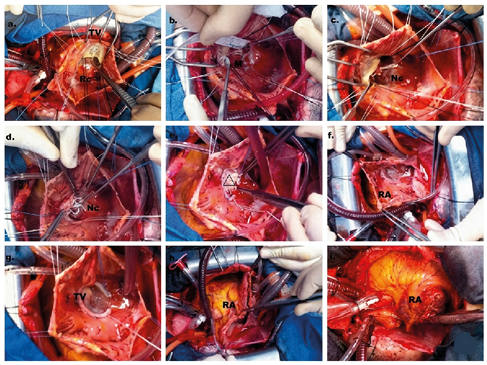
Figure 2. Tricuspid valve repair; [a: Ruptured cordae (Rc), b: Edge to moderator band (M) measure of neo-cordae, c: Implantation of neo-chordae loops stem to moderator band (M), d: Neo-chordae attachments to TV edges, e: Triangular plication of prolabe tricuspid valve (TV), f: Right atrial (RA) view after valvuloplasty, g: Coaptation test, h: Right atrial closure technique, i: New double chambered right atrium. ] Movie 1. Tricuspid Valve, Postoperative Doppler Echocardiography
Additional Information
Publisher’s Note
Bayrakol MP remains neutral with regard to jurisdictional and institutional claims.
Rights and Permissions

This work is licensed under a Creative Commons Attribution-NonCommercial 4.0 International License (CC BY-NC 4.0). To view a copy of the license, visit https://creativecommons.org/licenses/by-nc/4.0/
About This Article
How to Cite This Article
Kemal Korkmaz, Serhat Bahadır Genç, Ali Baran Budak, Hikmet Selçuk Gedik, Kerim Çağlı. Late posttraumatic tricuspid valve insufficiency repaired by artificial cordae: A Case Report. Eu Clin Anal Med 2026;2(3):23-25. doi:10.4328/ECAM.36
- Received:
- 13.09.2014
- Accepted:
- 17.09.2014
- Published Online:
- 19.09.2014
- Printed:
- 19.09.2014