
Abstract
Aim In this study, it was aimed to investigate the sociodemographic characteristics, fertility characteristics and attitudes towards family planning of women who applied to the Family Medicine Polyclinic.Methods This research; The study was conducted with 448 women between the ages of 15-49 years who applied to Konya Selcuk University Faculty of Medicine Family Medicine Polyclinic between 15 May 2022 and 15 July 2022. A questionnaire consisting of 18 questions was administeredapplied to the women in the family medicine outpatient clinic.Results 30.8% of the women included in the study are were between the ages of 15-34 years. 93.3% of women used a family planning method. The most commonly used method was birth control pill (26.3%). Among the family planning methods used, the most satisfied method was condom (14.3%).Conclusion The short time between recurrent pregnancies and miscarriages are is the basis of maternal and child health problems. These problems stem from the fact that family planning use and education levels are not at the desired level. In order to overcome these problems, it is important to give priority to the education of women and to inform them about family planning methods.
Keywords
Introduction
The ability of people to have as many children as they want and whenever they want and to determine the size of their family is called family planning (FP). Today, FP is an integral part of general women’s health and safe motherhood programs. FP is an important health service that contributes positively to the health of mothers and babies by preventing both unwanted pregnancies and excessive fertility, thus playing a role in increasing the health level of the society.1-2
Preventing pregnancy for family planning is called contraception, and the methods used for this purpose are called contraceptive methods. Many people use contraception to plan the number of children at appropriate time intervals. Some people may seek contraception due to their illnesses and health problems. When using contraception due to health problems, choosing the appropriate contraception with the least side effects is also important.2
It is essential for family physicians who provide multifaceted care services to individuals and families to have up-to-date information about the consultancy, effectiveness, reliability and side effects of these methods. It is thought that determining why women prefer the family planning method they use is important in terms of shedding
light on healthcare professionals in planning the service. It is thought that it is important to make this definition in order to disseminate the reasons for choosing effective methods and to prevent the reasons for choosing ineffective methods.3
According to the 2018 Turkey Population Health Survey 2018 data, while the general fertility rate in Turkey is 2.3, the rate of using any family planning method is 70%.4 Among the methods used,; withdrawal method the rate of withdrawal method is 20%, the male condom is 19%, IUD is 14%, and tubal ligation is 10% .
This research aims to investigate women’s sociodemographic characteristics, fertility characteristics and attitudes towards family planning.
Materials and Methods
The survey was administered using a face-to-face interview technique to a total of 448 female patients between the ages of 15-49 years who applied to Konya Selçuk University Faculty of Medicine Family Medicine Polyclinic between 15 May 2022 and 15 July 2022. The survey consists of 18 questions aiming to evaluate women’s sociodemographic information and their knowledge and attitudes towardsabout contraceptive methods.Ethical ApprovalEthical approval for this study was obtained from the Ethics Committee of Selçuk University Faculty of Medicine (Date: 26.042022; Decision No: 2022/211).Statistical AnalysisStatistical analyses were performed using SPSS (Statistical Package for the Social Sciences) version 22.0 for Windows. Descriptive statistics were presented as mean, standard deviation, median, minimum, and maximum values. The chi-square test was used to compare qualitative variables. A p value of <0.05 was considered statistically significant.Reporting GuidelinesThis study was conducted and reported in accordance with the STROBE guidelines.
Results
Study Participants included in the research;The distribution of some sociodemographic characteristics such as age groups, place of residence, educational status, smoking and alcohol use, and fertility characteristics are shown in Table 1. 30.8% of the participants are were between the ages of 15-34 years, and 69.2% are were aged 35 and over. 66.5% of the participants lived in the city center and 33.5% lived in a district or village;. 27.6% of these women were illiterate or primary school graduates, 29.5% were high school graduates, and 42.9% were undergraduate or master’s degree graduate graduates. It was observed that the rate of smoking among the participants was 37.9%, and the rate of alcohol use was 12.5%. The unintended pregnancy rate was found to be 21.9%, and the rate of curettage was found to be 17%. At the end of the research, it was determined that the average age of women was 40.00 ± 6.83, the marriage age was 23.00 ± 4.27, the number of living children was 2.00 ± 1.32 and the number of stillbirths was 2.00 ± 0.50.
It was determined that 93.3% of the women participating in the research used a family planning method and 87.5% had knowledge about family planning. 6.7% of the participants stated that they did not use any family planning method. It was determined that 83.7% of women using the FP method were satisfied with the birth control method they were using, 9.6% were dissatisfied, and 6.7% were undecided. 30.6% of the women stated that they became pregnant despite using any contraceptive method (CM) (Table 2).
The distribution of contraceptive methods used by women is shown in Figure 1. Birth control pills were found to beaccounted for 26.3%, withdrawal method 17%, calendar monitoring 15.6%, IUD 11.2%, morning after pill 8.9%, condom 8.5%, permanent method use 5.8% (Figure 1). The contraceptive methods used by women according to their age groups were examined. 53.6% of women aged 15-34 years using contraceptive methods were useding an effective family planning method, and 36.1% of women aged 35 years and over were useding an effective family planning method. FP methods used by women were evaluated according to their age ranges. The most frequently used contraceptive method was the birth control pill, both among those aged 15-34 years (35.9%) and those aged 35 years and over (24.8%). The second most frequently used contraceptive method between the ages of 15-34 was the withdrawal method, which has limited effect, with a rate of 21.9%. The second most frequently used contraceptive method among those aged 35 years and over was calendar tracking, which also has a limited effect, with a rate of 17.9%.
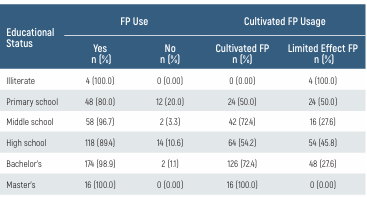
As stated in Table 3, when considering the distribution of FP use and women’s educational status, is examined; it was observed that all illiterate women, 80% of primary school graduates, 96.7% of secondary school graduates, 89.4% of high school graduates, 98.9% of undergraduate graduates, and all master’s degree graduate graduates used any contraceptive method. A statistically significant difference was detected between these groups (p=0.00).
The distribution of effective FP method use according to women’s educational status was investigated (Table 3). None of the illiterate women were useding an effective FP method. 60% of women with primary school degrees, 73.3% of women with secondary school degrees, 59.1% of women with high school degrees, 72.7% of women with bachelor’s degrees, and all women with master’s degrees were useding an effective FP method. A statistically significant difference was detected between these groups (p=0.00).
In our study, 88.5% of women without children, 88.9% of women with 1 child, and 96.9% of women with 2 children were useding the FP method. All women with 3 children, 87.1% of women with 4 children, and all women with 5 children were useding an the FP method. A statistically significant difference was detected between the increase in the number of children and the use of FP (p=0.002).
Discussion
According to the results of this study, 93.3% of women use any FP method. According to the results of the 2018 Turkey Demographic and Health Survey (TDHS) 2018, 70% of women aged 15-49 years in Turkey use any of the family planning methods.4 According to our study results, the rate of women using any family planning method is higher compared to the 2018 TDHS 2018 results. However, it is an undesirable result is that 17% of these women used limited effect methods such as withdrawal method and 15.6% used the calendar method. In a study conducted at Hacettepe University in 2013, it was determined that married couples were the most likely to use the the method most used by married couples was withdrawal method, with a rate of 63.8%.1 What is noteworthy in this study is that although 99.7% of the participants stated that they had information about an effective birth control method, the most frequently used method was still the withdrawal method.
As seen in Table 3, Women using FP in our study most frequently preferred effective modern methods (65.1%). The rate of those who prefer traditional methods with limited effect is 34.9%. In Our study, it was determined that the birth control method most frequently used by women was the birth control pill, with a rate of 26.3%. Afterwards, it was observed that the most frequently used FP method was the withdrawal method with a rate of 17%. According to the 2018 TDHS 2018 results, the most commonly used FP method in Turkey is the withdrawal method, which is a traditional method with a rate of 20% . Similar to the 2018 TDHS 2018 results, Öztaş et al. in 2015, it was observed that the most frequently used FP method by women was the withdrawal method with a rate of 26.4%.5 In the study conducted by Karabulutlu and Ersöz in 2017, it was determined that the FP method most frequently used by women of childbearing age was IUD with a rate of 28.8%.6
The use of Using family planning methods and reproductive behaviors are affected by the educational status of individuals.7 In our research, it was determined that there was a statistically significant relationship between the increase in women’s education levels and the use of FP (p = 0.000). It has been observed that as the education level of women increases, the use of FP also increases. Similarly, in the study of by Öztaş et al., it was determined that as the education level of women increased, their knowledge and use of family planning increased.5
It has been observed that as the education level increases, women’s use of FP increases as well as their use of an effective FP method. It was determined that there was a statistically significant relationship between the increase in women’s education levels and the preferred FP method being an effective method (p = 0.000). Many studies have shown that the success rates of traditional methods are much lower than modern methods.8-9 Similar to our study, a study by Aydoğdu and Akça in 2018 showed that there was a statistically significant relationship between educational status and effective FP use. It has been observed that as the education level of women increases, the preference for an effective FP method also increases (p<0.05).10 This suggests that increasing women’s education levels may affect their attitudes, behaviors and choice of method selection regarding family planning methods.
In our study, a statistically significant relationship was found between the increase in the number of children and the use of FP (p=0.000). It was determined that as the number of children increased, the use of FP also increased. In a study conducted by Altıparmak and Adıgüzel in 2006, similar to our research, as the number of living children increases, the rate of using the FP method also increases.11
Similar to our study, in other studies conducted in our country, the first priority is to obtain information from healthcare professionals.4,6 Our study is important as it shows that most women receiveget information about FP primarily from healthcare personnel. Obtaining Getting information from health professionals can increase women’s access to accurate and reliable information about family planning. According to the 2018 TDHS 2018, 52% of women using modern methods obtain the method they use from the public sector.4 Women should be encouraged to obtain such information from health professionals and health institutions.
There are many factors that affect the use of the FP method. These may include be the reliability of the method, misuse of the method and false beliefs about the method, expectations of the society, and the attitude of the individual and the family.1-3 In order to provide FP factors services effectively, it is necessary to determine the usage status of FP methods, the state of influence and the attitude towards FP.
Limitations
This study was conducted in a single center and the data were obtained through a questionnaire, which may limit the generalizability of the findings.
Conclusion
In our country, the basis of maternal and child health problems are based the short interval between repeated pregnancies and miscarriages. The basis of these problems lies in the fact that individuals’ FP use and education levels are not at the desired levels. Therefore, in solving these problems, it is important to prioritize the education of women and to inform women of childbearing age about FP methods. Again, since the high frequency of use of limited effective methods such as withdrawal method and calendar tracking in our country may increase the frequency of unwanted pregnancies and lead to maternal and child deaths and diseases, family planning education programs should be organized. The use of modern family planning methods should be increased. A more educational and effective approach to educating women about various methods of contraception will enable every woman, regardless of educational attainment, marital status or age, to make the right choice for themselves and their partners in using a method that will work effectively.
Declarations
Ethics Declarations
The authors declare that all procedures performed in this study were conducted in accordance with institutional, national, and international ethical standards.
Animal and Human Rights Statement
This study was conducted in accordance with the ethical standards of the responsible institutional committee and the Declaration of Helsinki and its subsequent amendments.
Informed Consent
Written informed consent was obtained from all participants prior to enrollment in the study.
Data Availability
The datasets generated and/or analyzed during the current study are available from the corresponding author on reasonable request.
Conflict of Interest
The authors declare no conflicts of interest.
Funding
None.
References
- Gözükara F, Kabalcıoğlu F, Ersin F. Şanlıurfa ilinde kadınların aile planlamasına ilişkin tutumlarının belirlenmesi [Determination of women’s attitudes towards family planning in Şanlıurfa province]. Harran Üniversitesi Tıp Fakültesi Dergisi. 2015;12(1):9-16.
- Yücesoy İ, Çalışkan E. Kontrasepsiyon ve Aile Planlaması [Contraception and Family Planning]. In: Çiçek MN, Akyürek C, Çelik Ç, Haberal A., Kadın Hastalıkları ve Doğum Bilgisi [Gynecology and Obstetrics Information]. 2.nd ed. basım. Güneş Kitabevi, Ankara: Güneş Kitabevi; 2006.p.789-805.
- Tanrıverdi G, Özkan A, Şenveli S. Çanakkale’deki Kadınların Aile Planlaması Yöntemlerini Tercih Nedenleri [Reasons for Women in Çanakkale to Choose Family Planning Methods]. Fırat Tıp Dergisi. 2008;13(4):251-254.
- Avcı S, Mutlu S, Yigit F. Evli Kadınların Aile Planlaması Yöntem Tercihlerine Etki Eden Faktörler [Factors Affecting Women’s Family Planning Method Preferences]. Ebelik ve Sağlık Bilimleri Dergisi. 2021;4(2):128-138.
- Öztaş Ö, Artantaş AB, Tetik BK, Yalçıntaş A, Üstü Y, Uğurlu M. 18-49 Yaş Grubu Evli Kadınların Üreme Sağlığı ve Kontrasepsiyon Hakkındaki Bilgi, Tutum ve Davranışları [Knowledge, Attitudes and Behaviors of Married Women in the 18-49 Age Group About Reproductive Health and Contraception]. Ankara Med J. 2015;15(2):67-76.
- Karabulutlu Ö, Ersöz B. Kars İli, Susuz İlçe Merkezine Bağlı Aile Planlaması Yöntemi Kullanan 15–49 Yaş Grubu Evli Kadınlarda Kullanılan Yöntem ve Yöntem Seçimini Etkileyen Faktörler [The Method Used in Married Women in the 15-49 Age Group Using Family Planning Method in Susuz District Center of Kars Province and Factors Affecting Method Selection]. Caucasian J Sci. 2017;4(1):26-44.
- Ioannidi-Kapolou E. Use of contraception and abortion in Greece: a review. Reproductive Health Matters. 2004;12(24):174-183.
- Kost K, Singh S, Vaughan B, Trussell J, Bankole A. Estimates of contraceptive failure from the 2002 National Survey of Family Growth. Contraception. 2008;77(1):10-21.
- Black KI, Gupta S, Rassi A, Kubba A. Why do women experience untimed pregnancies? A review of contraceptive failure rates. Best Pract Res Clin Obstet Gynaecol. 2010;24(4):443-455.
- Aydoğdu SGM, Akça E. Amasya İl Merkezindeki Aile Sağlığı Merkezlerine Başvuran Kadınların Aile Planlaması Yöntem Kullanımı ve Etkileyen Faktörler [Family Planning Method Use and Affecting Factors by Women Applying to Family Health Centers in Amasya City Center]. STED/Sürekli Tıp Eğitimi Dergisi. 2018;27(6):384-391.
- Altıparmak S, Adıgüzel Z. Manisa’da yaşayan 15-49 yaş grubu evli kadınlarda aile planlaması yöntemleri ile ilgili bilgi, tutum ve davranışları; kırsal alan örneği [Knowledge, attitudes and behaviors regarding family planning methods among married women aged 15-49 living in Manisa; rural area example]. Türkiye Klinikleri Jinekoloji ve Obstetri Dergisi. 2006;20(3):142-149.
Tables
Table 1. Distribution of some sociodemographic characteristics and fertility characteristics of the participants
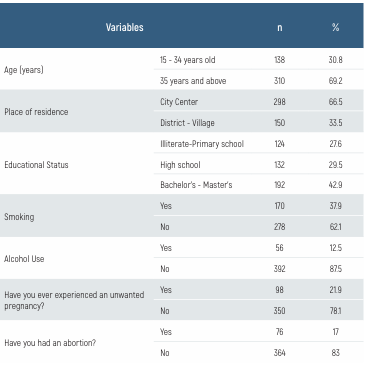
Table 2. Participants’ knowledge and attitudes towardsabout FP and CM
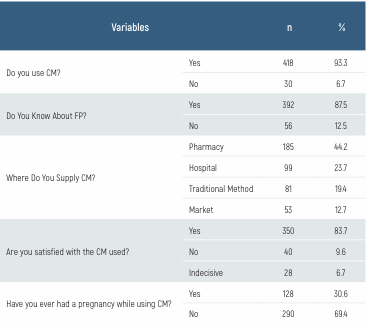
Table 3. Comparison of FP use and effective FP method use according to women’s educational status
Figures
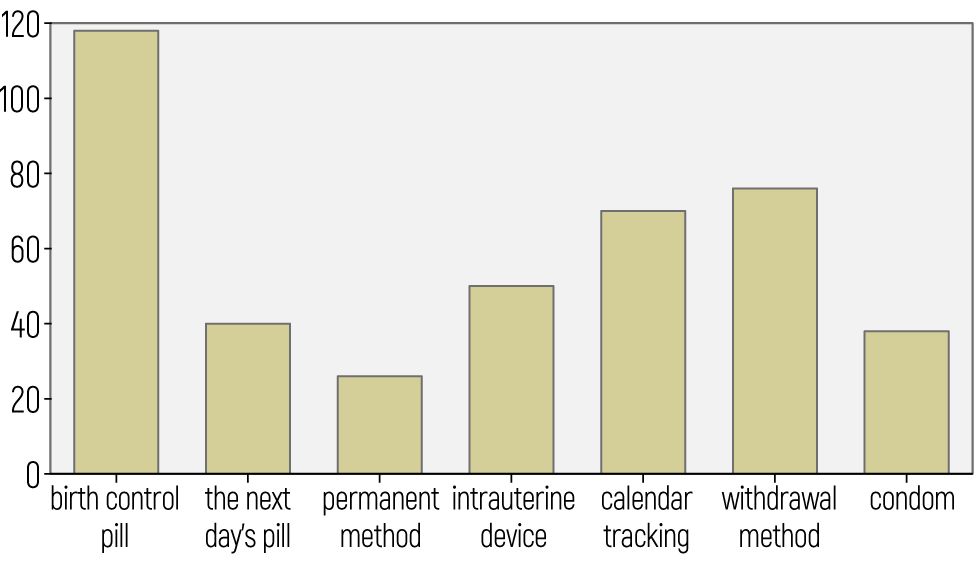
Figure 1. Contraceptive methods used
Additional Information
Publisher’s Note
Bayrakol MP remains neutral with regard to jurisdictional and institutional claims.
Rights and Permissions

This work is licensed under a Creative Commons Attribution-NonCommercial 4.0 International License (CC BY-NC 4.0). To view a copy of the license, visit https://creativecommons.org/licenses/by-nc/4.0/
About This Article
How to Cite This Article
Bahar Ürün Ünal, Burcu Gök Erdoğan. Use of family planning methods and attitudes of married women aged 15-49 in Konya Province. Eu Clin Anal Med 2024;12(1):5-8. doi:10.4328/ECAM.10076
- Received:
- 09.10.2023
- Accepted:
- 20.11.2023
- Published Online:
- 22.12.2023
- Printed:
- 01.01.2024