The effect of the presence of multiple arteries on living renal donor selection
Renal graft with multiple arteries
Authors
Abstract
AimDonor kidneys with multiple renal arteries induce a challenge for transplant surgeons in association with the processes of living donor nephrectomy and graft implantation. Assessment of the selection criteria in regard to the number of the renal arteries was aimed in the present study.
MethodsBetween February 2015 and October 2018, 279 renal donors underwent laparoscopic donor nephrectomy. Data were collected retrospectively. The patients were separated into two groups up to the number of the renal arteries (Group A: single artery, Group B: ≥2 arteries). Two groups were compared according to warm/cold ischemia time and complications. Besides, the right-sided and single artery donors were compared with left-sided and multiple arteries donors in accordance with the same criteria.
ResultsSingle artery was present in 224 donors as group A (80,2%) and fifty donors had double arteries (18%) and there were three arteries in five donors (1,8%). In brief, there were 55 donors in Group B (19,8%). Groups were similar in terms of age, gender, and BMI. Warm ischemia time has shown no statistical difference between groups. However, cold ischemia time was significant long in Group B (p < 0.005). The vascular complication rates were similar in both groups.
ConclusionThe presence of multiple renal arteries poses any challenge for the selection of donor renal graft. Although the grafts with multiple arteries cause longer cold ischemia time, there is no effect on primary graft function.
Keywords
Introduction
Laparoscopic donor nephrectomy (LDN) is the most used surgical method for organ procurement in living donor renal transplantation (LDRT). Left-sided renal grafts with a single artery were preferred in the early years due to donor safety and the lack of experience in LDN.1 However, the ongoing supply-demand mismatch between the available organs and patients obligates transplant surgeons to maximize the donor pool. For this purpose, procurement grafts with multiple arteries and right-sided donor nephrectomy were expanded worldwide especially in experienced centers.2,3 This study has focused on comparing the laparoscopic procurement of renal grafts with single artery and multiple arteries regarding surgical procedure and early graft outcomes.
Materials and Methods
The design of the study was retrospective in its nature. It was approved by the local ethics committee with protocol number 2019-18/3. Between February 2015 and October 2018, 279 LDN were performed at our institution. The patients were reviewed on a retrospective basis, and the features of the patients were recorded.
The patients were divided into two groups up to the number of the renal arteries (Group A: single artery, Group B: ≥2 arteries). Surgical characteristics such as operating time, cold/warm ischemia time, and complications were compared between two groups.
Statistical AnalysisComparisons were analyzed using the Chi-square test for categorical variables and the Mann-Whitney test for independent values. A p-value of p<0.05 was considered statistically significant in all analyses.
Results
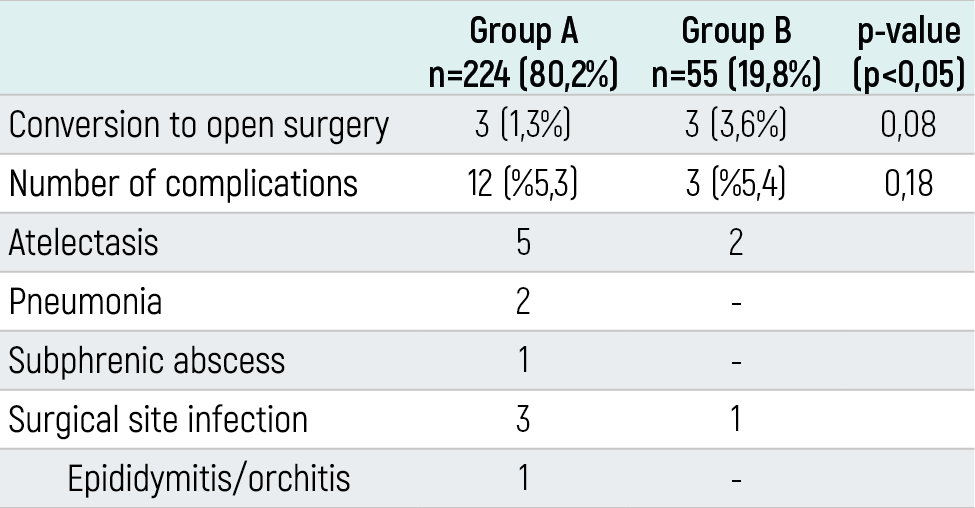
Group A and B have involved 224 (80,2%) and 55 patients (19,8%), respectively. The groups were similar according to age, gender, and BMI (Table 1). The mean operating time has shown no statistical difference in groups. The mean warm ischemia time was similar in both groups. But, the cold ischemia time was significantly shorter in group B. The mean length of hospital stay was also similar in both groups (Table 2). Conversion to open donor nephrectomy was experienced in three and two patients in group A and B, respectively. The causes of conversion were bleeding in two patients and the difficulty of laparoscopic dissection due to former surgery in three patients. The rates of postoperative complications were also similar in the groups (Table 3).
Discussion
The vascular structure of donor grafts wass assessed by computed tomography/angiography (CTa) in our center. A recent study based on our population has focused on comparing the results of CTa and the surgical findings.4 This study reported 97%, 98%, 95% rates for accuracy, sensitivity, and specificity in determining multiple renal arteries, respectively. In our study, preoperative CTa has missed accessory artery smaller than 2cm in two cases. The same study has also reported that 63% of donors had bilateral single renal artery. This rate was 59% in our series. Multiple renal arteries in kidneys were reported 18% to 43% in the literature and our rate is slightly high.5 Earlier, avoiding procurement of grafts with multiple renal arteries was associated with preventing vascular complications. A report from Europe has shown that the reason for selecting right-sided donor nephrectomy was multiple vessels on left-sided kidneys.6
The necessity of expanding the donor pool and growing experience in the laparoscopic era have led to use of grafts with multiple arteries.5 In the last two decades, an increasing number of studies have proven the safety of LDN for grafts with multiple renal arteries.7 Our complication rates for LDN were also consistent with the results of recent studies.8,9 In the only study, it was reported that the vascular complications were higher in multiple arteries group.10 In theory, the procurement of grafts with multiple arteries leads to increase ischemic time and duration of anastomoses more than a single vessel. A recently reported meta-analysis.3 has demonstrated that there were no significant differences between multiple arteries and single artery in terms of donor hospital stay, warm ischemia time, and surgical complications, but the operating time was longer in multiple arteries donors. Our results were similar to this meta-analysis. However, implanting multiple arteries grafts causes longer cold ischemia time that might lead to delayed graft function. Two meta-analyses have demonstrated that cold ischemia time is significantly longer in multiple arteries graft and the rate of delayed graft function is higher than those with a single artery.3,7 Although our results have shown longer cold ischemia time in multiple arteries group, the risk of delayed graft function was similar to those with a single artery.
Conclusion
This study demonstrated that the procurement of grafts with multiple arteries has no effect on the outcomes of donor. Although the cold ischemia time is longer for grafts with multiple arteries, we detected no influence on early graft function in a recent study. In high-volume and experienced centers, the number of artery of the graft should not determine selecting the donor graft.
Declarations
Animal and Human Rights Statement
All procedures performed in this study involving human participants were in accordance with the ethical standards of the institutional and national research committee and with the Declaration of Helsinki and its later amendments.
Informed Consent
Written informed consent was obtained from all participants before donor nephrectomy and transplantation procedures.
Conflict of Interest
The author declares no conflict of interest.
Funding
None.
Scientific Responsibility Statement
The author declares that he is responsible for the scientific content of the manuscript, including study design, data collection, analysis and interpretation, manuscript preparation, and approval of the final version of the manuscript.
References
-
Keller JE, Dolce CJ, Griffin D, Heniford BT, Kercher KW. Maximizing the donor pool: use of right kidneys and kidneys with multiple arteries for live donor transplantation. Surg Endosc. 2009;23(10):2327-2331. doi:10.1007/s00464-009-0330-9
-
Al-Oraifi I, Tawfeeq M, Al-Hellow H, Al-Qahtani MS, Al-Bugami MM, Al-Shahrani, et al. Laparoscopic donor nephrectomy of dual renal artery kidneys: single-center experience. Chirurgia (Bucur). 2017;112(2):124-129. doi:10.21614/chirurgia.112.2.124
-
Afriansyah A, Rasyid N, Rodjani A, Wahyudi I, Mochtar CA, Susalit E, et al. Laparoscopic procurement of single versus multiple artery kidney allografts: meta-analysis of comparative studies. Asian J Surg. 2019;42(1):61-70. doi:10.1016/j.asjsur.2018.06.001
-
Çıra K, Demirtaş H, Durmaz MS, Çeken K. Evaluation of renal arteries of 286 living donors by multidetector computed tomography angiography: a single-center study. Exp Clin Transplant. 2015;13(6):581-587. doi:10.6002/ect.2015.0016
-
Chedid MF, Muthu C, Nyberg SL, Lesnick TG, Kremers WK, Prieto M, et al. Living donor kidney transplantation using laparoscopically procured multiple renal artery kidneys and right kidneys. J Am Coll Surg. 2013;217(1):144-152. doi:10.1016/j.jamcollsurg.2013.04.010
-
Kok NF, Weimar W, Alwayn IP, Ijzermans JN. The current practice of live donor nephrectomy in Europe. Transplantation. 2006;82:892-897. doi:10.1097/01.tp.0000235511.19629.0d
-
Zorgdrager M, Krikke C, Hofker SH, Leuvenink HG, Pol RA. Multiple renal arteries in kidney transplantation: a systematic review and meta-analysis. Ann Transplant. 2016;21:469-478. doi:10.12659/aot.898748
-
Kwapisz M, Kieszek R, Bieniasz M, Jędrzejko K, Nita M, Sułkowska K, et al. Do anatomical anomalies affect the results of living donor kidney transplantation? Transplant Proc. 2018;50(6):1669-1673. doi:10.1016/j.transproceed.2018.03.119
-
Paragi PR, Klaassen Z, Fletcher HS, Tichauer M, Chamberlain RS, Wellen JR, et al. Vascular constraints in laparoscopic renal allograft: comparative analysis of multiple and single renal arteries in 976 laparoscopic donor nephrectomies. World J Surg. 2011;35(9):2159-2166. doi:10.1007/s00268-011-1168-6
-
Crane C, Lam VW, Alsakran A, Vasilaras A, Lau H, Ryan B, et al. Are there anatomical barriers to laparoscopic donor nephrectomy? ANZ J Surg. 2010;80(11):781-785. doi:10.1111/j.1445-2197.2010.05439.x
Tables
Table 1. Demographic characteristics
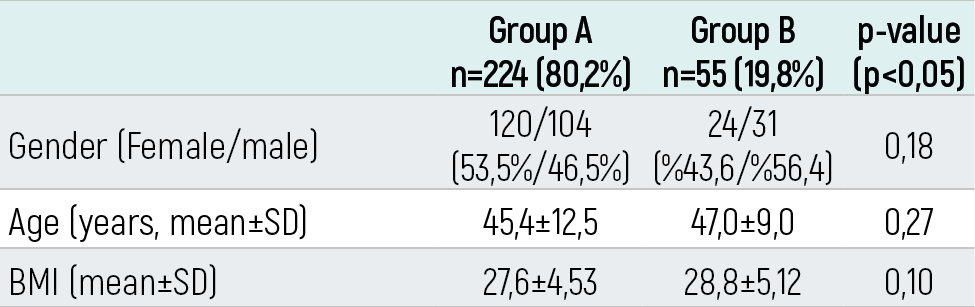
Table 2. Surgical characteristics of donor
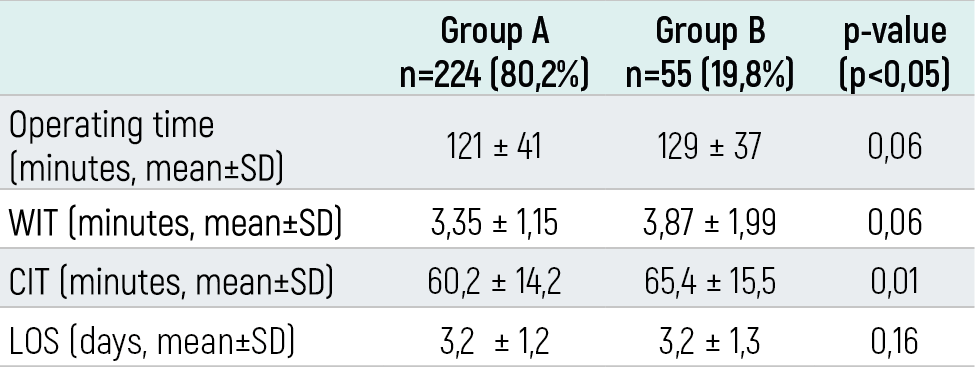
WIT: warm ischemia time, CIT: cold ischemia time, LOS: length of hospital stay
Table 3. Complications of donor nephrectomy.
Additional Information
Publisher’s Note
Bayrakol MP remains neutral with regard to jurisdictional and institutional claims.
Rights and Permissions

This work is licensed under a Creative Commons Attribution-NonCommercial 4.0 International License (CC BY-NC 4.0). To view a copy of the license, visit https://creativecommons.org/licenses/by-nc/4.0/
About This Article
How to Cite This Article
Hikmet Aktas. The effect of the presence of multiple arteries on living renal donor selection. Eu Clin Anal Med 2020;8(2):12-14. doi:10.4328/ECAM.10022
- Received:
- February 24, 2020
- Accepted:
- March 21, 2020
- Published Online:
- March 28, 2020
- Printed:
- June 1, 2020