The investigation of toxoplasma gondii seropositivity in pregnant women
Toxoplasma gondii seropositivity
Authors
Abstract
AimToxoplasma infections are particularly serious if they occur during pregnancy and may result in abortion, death and congenitally acquired disorders. The purpose of this study was assessing seroprevalence of Toxoplasma gondii infection and compare the other regions in Turkey.
MethodsToxoplasma gondii antibodies were investigated in 6129 pregnant women’s serum samples from January 2012 to December 2014 in this retrospective study. The serum samples were analysed by Enyzme Linked Immunosorbent Assay (ELISA).
ResultsIgM antibodies against Toxoplasma gondii were detected 0.3% (n=10) and Toxoplasma IgG antibodies were 20.3% (n=446) in pregnant women.
ConclusionAlthough our study results were similar to study conducted in other regions, our results were relatively low. Therefore, especially screening of risk groups (contact with cats, raw meat consumption, etc.) is more useful in terms of the cost-effectiveness.
Keywords
Introduction
Toxoplasmosis is an infection caused by Toxoplasma gondii which is obligate intracellular protozoan. It is widely distributed throughout the world and it can involve all organs. Last host is felines and it is transmitted to humans from raw meats and unwashed vegetables which contaminated with oocysts in the feces of cats. It is reported that they are found more common in hot and humid place in compared to cold and dry place.1,2,3,4 Toxoplasma infection in pregnant women is usually mild and asymptomatic. Infection can transmitted to the fetus transplacentally if an acute infection occurs 6-8 weeks before or during pregnancy. The risk of transmission from mother to the fetus increases with gestational age. It is 10-15% in the first trimester, 30-54% in the second trimester, and increases to 80% in the last months of pregnancy. Although transmission risk increases with gestational age, the risk of severe disability in the fetus is 75% in the first trimester, and 0% in the last trimester. The risk of congenital infection is reduced 60% if the mother is treated. Therefore it is very important to detect infection immediately prior to the pregnancy or during pregnancy.1,4,5,6,7,8,9,10 Th1-type inflammatory environment is essential for endometrial invasion by trophoblast during implantation. It is also necessary for the growth and protection against infection of the spiral arteries in the first month of pregnancy.11,12 Implantation is stimulated by IFNγ which activates NK cells, regulates colony stimulating factor and promotes the growth of trophoblast.13. Th1 / Th2 regulatory T cell cytokines are in a delicate balance in pregnancy in order to support fetal growth and to prevent rejection by the maternal immune response (allorejection). Inflammatory Th1 response rises again at the end of pregnancy to initiate premature rupture of membranes, placental abruption, and to support delivery.14,15 Transplacental passage of maternal IgG protects the newborn against infection and it is thought that most of IgGs passes in the third trimester. Congenital toxoplasmosis is very complicated disease, therefore result of the disease depends on the mother’s, conceptus’s and parasite’s genetic information. Polymorphism of genes involved in these parallel phenomena, such as Toll-like receptors (TLRs), adhesins, cytokines, chemokines or their receptors, immunoglobulins or Fc receptors (FcRs), might be important in susceptibility for Toxoplasma gondii vertical transmission, abortion or fetal pathology.6 The purpose of this study is to determine the Toxoplasma gondii antibodies seropositivity rates in patients who admitted to our clinic between January 2012 and December 2014.
Materials and Methods
Toksoplazma Gondii IgM and IgG results in 6129 pregnant women between the ages of 15-45 were retrospectively investigated in the period from January 2012 to December 2014. Anti-Toxoplasma gondii IgG and IgM antibodies in blood samples were analyzed by Enzyme Linked Immunosorbent Assay (ELISA) method.
Results
A mean age of pregnant women who enrolled to our study was found 26.9 ± 6.1 years old (age range was 15-45). In our study, the anti-Toxoplasma IgM result was positive in 10 out of 3930 (0.3%) serum example and anti-Toxoplasma IgG result was positive in 446 out of 2199 (20.3%) serum samples (Table 1).
Discussion
Toxoplasmosis patterns in pregnancy is usually mild or asymptomatic, but it sometimes causes serious complications such as abortion, fetal death, neurological problems like neonatal hydrocephalus, intracranial calcifications and chorioretinitis (classical triad) and hematological problems. Therefore, it is important to make diagnosis timely and accurately.2 Screening for toxoplasmosis should be done in the early weeks of pregnancy. Detection of negative IgM and IgG antibodies excludes the disease in pregnants who had never encountered to the Toxoplasma antigen. Cosequenly, these pregnants are at risk for toxoplasmosis and they should be warned about eating raw meat and consuming unwashed fruits and vegetables.
The incidence of seropositivity for antibodies against Toxoplasma in human is vary in terms of age, climate, eating habits, socioeconomic and hygienic conditions. It was reported that toxoplasma seropositivity rates were around 50% in the general population and 54.4% in pregnant women in France, 19-30% in the general population and 39.4% in pregnant women in United States, and around 75.2% in pregnant women in Taiwan depending on the raw meat eating habits.8,16 It was reported from studies conducted in different parts of the Turkey that Toxoplasma IgM positivity was between 0.3-3.0% and Toxoplasma IgG positivity was between 18.3-69.6%.17,18,19,20 In a study conducted in Çanakkale, Toxoplasma IgG and IgM antibodies positivity were 28.8% and 2.7% respectively.18 Kölgeli et al19 conducted a study in pregnant women in Adiyaman. The toxoplasma seropositivity rate in the 17-25 years, 26-35 years and 36-45 years age groups were 42.6%, 48.6% and 62.1% respectively. The seropositivity rate was statistically significantly higher in the 36-45 age group than the other age groups.19 The seropositivity rates were 3% for the Toxoplasma IgM and 69.6% for the Toxoplasma IgG in women in Sanliurfa.20 This rates are the highest rate ever reported in Turkey. This high prevalence of IgG seropositivity rate is thought to be caused by the consumption of raw meat in this region. It was reported that these rates were 1.7% for the Toxoplasma IgM and 36% for the Toxoplasma IgG in women in Van.21 Although our study results were similar to the results of the other studies conducted in different regions, it seems to be relatively low. This situation can be attributed to the lack of raw meat consumption culture, cold and dry climate in our region and very limited contact with cats. We believe that our study’s data contributes to the literature. As a result; based on the relatively low seropositivity rates in our region it might be more useful to focus on the risk groups instead of the routine screening of all pregnant women in terms of cost effectiveness.
Declarations
Animal and Human Rights Statement
All procedures performed in this study were in accordance with institutional and national ethical standards and the 1964 Helsinki Declaration and its later amendments (or comparable ethical standards).
Informed Consent
Informed consent was obtained from all participants.
Conflict of Interest
The authors declare no conflicts of interest.
Funding
None.
Scientific Responsibility Statement
The authors declare that they are responsible for the scientific content of the article, including the study design, data collection, analysis and interpretation, manuscript preparation, and approval of the final version of the manuscript.
References
-
Kuman HA, Altıntaş N, eds. Protozoon hastalıkları. Ege Üniversitesi Basımevi; 1996:112.
-
Remington JS, Desmonts G. Toxoplasmosis. In: Remington JS, Klein JO, eds. Infectious diseases of the fetus and newborn infant. WB Saunders; 1990:89-174.
-
Mandell GL, Bennett JE, Dolin R. Toxoplasma gondii. In: Montoya JG, Remington JS, eds. Mandell, Douglas, and Bennett’s principles and practice of infectious diseases. 5th ed. Churchill Livingstone; 2000:2858-2888.
-
Topçu AW, Söyletir G, Doğanay M. Toxoplasma gondii. In: Kuman AH, ed. Enfeksiyon hastalıkları ve mikrobiyolojisi. Nobel Tıp Kitabevleri; 2002:1883-1897.
-
Doğanay M, Altıntaş N. Toxoplasmosis. In: Hökelek M, Açıcı M, eds. Zoonozlar: hayvanlardan insanlara bulaşan enfeksiyonlar. Bilimsel Tıp Yayınevi; 2009:803-830.
-
Ortiz-Alegría LB, Caballero-Ortega H, Cañedo-Solares I, et al. Congenital toxoplasmosis: candidate host immune genes relevant for vertical transmission and pathogenesis. Genes Immun. 2010;11(5):363-373. doi:10.1038/gene.2010.21
-
Mandell GL, Bennett JE, Dolin R. Toxoplasma gondii. In: Montoya JG, Remington JS, eds. Mandell, Douglas, and Bennett’s principles and practice of infectious diseases. 5th ed. Churchill Livingstone; 2000:2294-2310.
-
Topçu AW, Söyletir G, Doğanay M. Toxoplasma gondii. In: Töre O, ed. Enfeksiyon hastalıkları ve mikrobiyolojisi. Nobel Tıp Kitabevleri; 2002:676-685.
-
Montoya JG, Liesenfeld O. Toxoplasmosis. Lancet. 2004;363:1965-1976. doi:10.1016/s0140-6736(04)16412-x
-
Dunn D, Wallon M, Peyron F, Petersen E, Peckham C, Gilbert R. Mother-to-child transmission of toxoplasmosis: risk estimates for clinical counselling. Lancet. 1999;353:1829-1833. doi:10.1016/s0140-6736(98)08220-8
-
Szekeres-Bartho J. Immunological relationship between the mother and the fetus. Int Rev Immunol. 2002;21(6):471-495. doi:10.1080/08830180215017
-
Chaouat G, Ledee-Bataille N, Dubanchet S, et al. Th1/Th2 paradigm in pregnancy: paradigm lost? Cytokines in pregnancy/early abortion: reexamining the Th1/Th2 paradigm. Int Arch Allergy Immunol. 2004;134(2):93-119. doi:10.1159/000074300
-
Hannan NJ, Salamonsen LA. Role of chemokines in the endometrium and in embryo implantation. Curr Opin Obstet Gynecol. 2007;19:266-272. doi:10.1097/gco.0b013e328133885f
-
Wilczynski JR. Th1/Th2 cytokines balance—yin and yang of reproductive immunology. Eur J Obstet Gynecol Reprod Biol. 2005;122:136-143.
-
Chaouat G. The Th1/Th2 paradigm: still important in pregnancy? Semin Immunopathol. 2007;29:95-113. doi:10.1007/s00281-007-0069-0
-
Guerra García C, Fernández Sampedro J. Seroprevalence of Toxoplasma gondii in pregnant women. Aten Primaria. 1995;16:151-153.
-
İnci A, Yener C, Demirhan G. Bir devlet hastanesinde gebe kadınlarda toksoplazma, rubella ve sitomegalovirüs seroprevalansının araştırılması. Pamukkale Tıp Derg. 2014;7:143-146.
-
Gencer M, Cevizci S, Saçar S, et al. Çanakkale Onsekiz Mart Üniversitesi Tıp Fakültesi hastanesi obstetri polikliniğine müracaat eden gebelerde anti-Toxoplasma gondii antikorlarının dağılımı ve risk faktörlerinin irdelenmesi. Türkiye Parazitoloji Derg. 2014;38:76-80.
-
Kölgelier S, Demiraslan H, Kataş B, Güler D. Gebelerde Toxoplasma gondii seroprevalansı. Dicle Tıp Derg. 2009;36:170-172.
-
Fikret T, Erdal Ö. Çiğ köftenin yaygın tüketildiği Şanlıurfa ilinde kadınlarda Toxoplasma gondii seroprevalansı. Türkiye Parazitoloji Derg. 2007;31(3):176-179.
-
Efe Ş, Kurdoğlu Z, Korkmaz G. Van yöresindeki gebelerde sitomegalovirüs, rubella ve toksoplazma antikorlarının seroprevalansı. Van Tıp Derg. 2009;16(1):6-9. doi:10.9775/kvfd.2011.4415
Tables
Table 1. Toxoplasma seropositivity among pregnant women in Kars
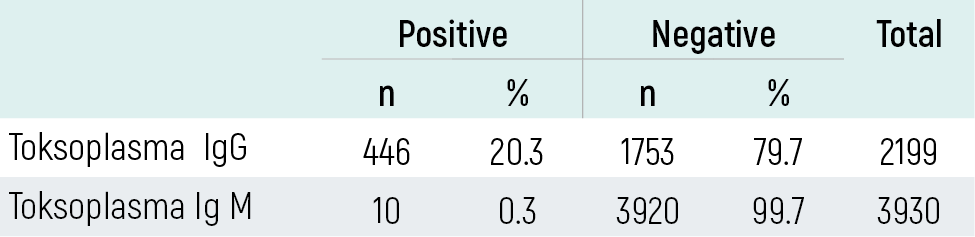
n: Number of cases
Additional Information
Publisher’s Note
Bayrakol MP remains neutral with regard to jurisdictional and institutional claims.
Rights and Permissions

This work is licensed under a Creative Commons Attribution-NonCommercial 4.0 International License (CC BY-NC 4.0). To view a copy of the license, visit https://creativecommons.org/licenses/by-nc/4.0/
About This Article
How to Cite This Article
Levent Sahin, Yakup Baykuş, Rulin Deniz, Yasemin Yavuz, Zuhal Tazegün, Atakan Tazegün, Osman Acar. The investigation of toxoplasma gondii seropositivity in pregnant women. Eu Clin Anal Med 2015;3(3):21-23. doi:10.4328/ECAM.61
- Received:
- October 22, 2015
- Accepted:
- October 26, 2015
- Published Online:
- October 26, 2015
- Printed:
- October 26, 2015