Examining the stress, depression, anxiety levels and communication skills of pet owners and non-pet owners
Psychological impact of pets
Authors
Abstract
Aim There are studies showing that pets have a positive effect on individuals’ psychological health. The aim of this study was to investigate the stress, depression, anxiety levels and communication skills of individuals with and without pets.
Methods A total of 240 volunteers living in Balıkesir province of Turkey, aged between 18-65, with and without pets were included in the study. The participants in the research group were required to have cats, dogs and birds at home and to have taken care of pets for at least 6 months. The “Demographic Information Form” was used for demographic information, the “Communication Skills Scale (CSS)” to measure basic communication skills, the “Perceived Stress Scale (PSS)” to determine the stress level, and the “Beck Depression Inventory (BDI)” and “Beck Anxiety Inventory (BAI)” to detect depression and anxiety symptoms, respectively. SPSS 27.0 program was used in the analyses. The significance level in the study was determined as α=0.05.
Results There was no significant difference (p>0.05) between the groups with and without pets in terms of age, gender distribution, marital status, education level, income status and the person they live with. While BDI, BAI, and ASQ were found to be significantly lower in the group with pets than in the group without pets (p<0.05), IAS was found to be higher.
Conclusion It was concluded that having a pet has positive effects on depression, anxiety, stress levels and communication skills. It is hoped that this study will shed light on future studies on animal-assisted therapy.
Keywords
Introduction
While studies have frequently been conducted in the past where animals were used for different purposes such as nutrition and labor, it has now been discovered that animals have a therapeutic spiritual interaction with humans. This has led researchers to this subject. In recent years, the number of pet owners worldwide has been increasing rapidly.1 A recent study in the United States reported that approximately 67% of homes have at least one pet.2 Pets affect human life in many ways today and have become indispensable members of homes. When the literature on this subject is examined, it is seen that there are many studies examining the relationship between humans and animals. One of the most important common features of the studies is that they provide various evidence that owning a pet can have positive effects on individuals’ physical and mental health by establishing deep emotional bonds.3 Owning a pet has many benefits in terms of mental health, such as improving mental health, reducing stress, depression, and anxiety, supporting social interaction, and increasing self-confidence and quality of life.4,5 A cross-sectional study in Bangladesh of pet owners aged 13 years and older reported that pet owners had 41% lower levels of depression compared to those without pets.6 Another study found that dog owners had fewer symptoms of depression and anxiety than non-dog owners.5
When we look at the research conducted in general, many pet owners state that they feel close to animals, that these animals offer them a more sincere relationship and unconditional love than people, and that this makes them feel better.7 It is also reported that the physical contact of animals kept in the home environment with their owners is in response to basic human needs. The fact that pets need the care of their owners gives the individual the duty of taking on all the responsibilities of another living being, such as care and feeding. It has been proven by research that this situation helps to create a sense of responsibility, prevents that person from feeling lonely and reduces the possibility of depression8 It is thought that children who have grown up in the same house with a pet since childhood may be more social and communicative individuals when they become adults. It has been reported that children who own dogs between the ages of 8-12 visit friends more often than children who do not own dogs.9
Although there are some qualitative studies that claim that pet ownership benefits people, especially improves mental health, there are also studies examining the relationship between pet ownership and mental health, showing that pet ownership has no effect or may even have negative effects. A comprehensive review published in 2021 compared the mental health outcomes or pet ownership status of pet owners and non-pet owners. While 17 of the 54 articles included in the study found a clear positive relationship between pet ownership and positive mental health, the remaining 37 articles reported a mixed relationship, no relationship, or a negative relationship. The contradictions in the literature and the limitations of these studies require a detailed evaluation of the effects of pet ownership on mental health in large and diverse populations.2 In addition, there is no study that evaluates depression, anxiety, stress levels, and communication skills together. In this context, the aim of our study is to investigate whether there is a difference between individuals who own and do not own pets in terms of stress, depression, anxiety levels, and communication skills as a result of a survey study to be conducted on a selected sample of 240 people. It is hoped that this research will shed light on future research on animal-assisted therapy.
Materials and Methods
PatientsThe population of the study consists of 240 individuals living in Balıkesir province of Turkey, between the ages of 18-65, who own a pet (120 individuals) and who do not own a pet (120 individuals). Participation is completely voluntary. After the participants signed the Voluntary Consent Form, the participants were divided into two main groups as the research group and the control group in order to conduct the intended analyses. While the participants in the research group were required to have cats, dogs and birds at home, the participants in the control group were required to not have any pets such as cats, dogs and birds at home. In addition, individuals who have taken on pet care for at least 6 months were included in the study.
Data Collection ToolsAs data collection tools in the study; “Demographic Information Form” created to collect demographic information, “Communication Skills Scale” to measure communication skills, “Perceived Stress Scale” to determine stress level, “Beck Depression Scale” to detect depression symptoms and “Beck Anxiety Scale” to detect anxiety symptoms were applied. The surveys used in the study were applied face to face.
BDI, developed by Beck and his colleagues, is used to determine depressive attitudes and symptoms of depression. The scale consists of 21 items. The items are scored between 0 and 3 on a 4-point Likert-type scale. The total score that can be obtained from the scale is between 0 and 63 points. A high score indicates an increase in depressive symptoms.10
Developed by Aaron T. Beck and his colleagues in 1988, the BAI aims to determine anxiety symptoms and their severity. It consists of 21 items and is a Likert-type scale. The items are between 0 and 3 points. The scores of the scale range from 0 to 63. An increase in the total score indicates that the individual’s anxiety intensity increases.11
The CSS, developed by Korkut-Owen and Bugay in 2014, consists of 25 items. It includes four sub-dimensions: communication principles and basic skills, self-expression, active listening and non-verbal communication, and willingness to communicate. It is a 5-point Likert- type questionnaire that progresses from “Never” to “Always.” The score that can be obtained from the scale varies between 25 and 125. A high score indicates that the individual has developed communication skills.12
PSS was developed by Cohen, Kamarck, and Mermelstein (1983) in 1983. It consists of 14 items in total and was developed to measure the degree to which certain situations in life are perceived as stressful. The scale is a 5-point Likert-type scale with the expressions Never (0), Almost Never (1), Sometimes (2), Quite Often (3), Very Often (4). PSS-14 scores range from 0 to 56.13
Ethical ApprovalThis study was approved by the Ethics Committee of Non-Interventional Clinical Research, Istanbul Medipol University (Date: 26 September 2024, Approval No: 925).
Statistical Analysis Mean, standard deviation, median lowest, highest, frequency and ratio values were used in descriptive statistics of the data. Kolmogorov- Smirnov, Shapiro-Wilk test was used for the distribution of variables, Kruskal-Wallis, Mann-Whitney U test was used for the analysis of quantitative independent data with non-normal distribution. Chi- square test was used in the analysis of qualitative independent data, and Fischer test was used when chi-square test conditions were not met. SPSS 27.0 program was used in the analyses.
Reporting GuidelinesThis study was reported in accordance with the STROBE guidelines.
Results
In our study, in which we investigated the stress, change, anxiety levels and communication activities of those with and without pets, no significant difference was found between the groups with and without pets in terms of age, gender, marital status, education level, income status and the person they live with (p>0.05) (Table 1). The BDI score and depression rate were found to be significantly (p<0.05) lower in the group with pets than in the group without pets. The BDI score and anxiety rate were found to be significantly (p<0.05) lower in the group with pets than in the group without pets. Similarly, the ASQ score was found to be significantly (p<0.05) lower in the group with pets than in the group without pets, while the IAS score was found to be significantly (p<0.05) higher in the group with pets than in the group without pets (Table 2).
Discussion
In a meta-analysis examining the effects of animal-assisted activities and animal-assisted therapy on reducing depressive symptoms, it was reported that animal-assisted activities and therapies were associated with lower depression symptoms. In the literature, the majority of studies on depression and anxiety symptoms in pet owners report positive results. One study showed that even a 20-minute session with a therapy dog can be an effective alternative treatment method for improving students’ well-being, anxiety, and mood.14 A study by Bolstad et al. showed that owning a pet was associated with fewer anxiety symptoms.15 Muldoon et al. reported that non-dog owners were three times more likely to report symptoms of depression than dog owners.16 Carr et al. reported fewer symptoms of depression and anxiety in dog owners than in non-dog owners.5 Contrary to these studies, there are also studies reporting that there is no relationship between pet ownership and depression and anxiety. Batty et al. argue that there is no evidence that owning a pet is clearly associated with symptoms of depression.17 The results of our study are similar to the majority of studies in the literature. According to the results of our study, depression and anxiety levels were found to be lower in pet owners compared to non-pet owners.
When looking at studies on stress, conflicting results are seen. Studies have concluded that pets have an effect on reducing a person’s depressive state and stress. In Wu et al.’s study, it was reported that pet owners had lower perceived stress levels and that dog owners, in particular, were more attached to their pets than other pet owners.18 One study found that dog companionship is a source of social support and is associated with a reduced risk of stress-related illnesses. It has also been found that just ten minutes of physical interaction and socialization with animals, dogs, and cats can significantly reduce levels of cortisol, a hormone associated with stress in humans.19 However, a recent study conducted in 2022 found that pet ownership had no significant effect on stress and anxiety, but concluded that long-term pet ownership had positive effects on depression.20 Our study also found that pet owners had lower stress levels than non-pet owners. When studies on communication skills and sociability are examined, it is seen that dogs have a strong effect on social interactions between people, encourage the formation of new social networks and strengthen communication. It is also reported that pets are effective in establishing empathy in communication, provide social connections, function as part of the family and develop self-esteem and self-sufficiency.21 Marsa-Sambola et al. argue that attachment to pets can improve communication with parents and friends.22 Another study investigating the role of pets in family systems states that animals generally serve to keep the family together, increase their harmony, and support interaction and communication between family members.23 A study that comprehensively describes the effects of pet owners’ perceptions of these animals on family members also found that pets provide social support and therefore improve the physical and mental well-being of their owners.24 Our study also found that communication skills were higher in pet owners compared to those who did not own a pet.
Limitations
This study has several limitations, including its cross-sectional design, single-province sample, and the use of self-reported questionnaires, which may limit causal inference and generalizability.
Conclusion
Our study has shown that living with animals has psychological benefits. In our study, where we investigated the stress, depression, anxiety levels and communication skills of individuals with and without pets, it was found that the mean scores from depression, anxiety and stress scales were lower in those with pets. It was also found that pet owners have better communication skills. It is hoped that this study will shed light on future research on animal-assisted therapy.
Declarations
Ethics Declarations
The study protocol was approved by the Ethics Committee of Non-Interventional Clinical Research, Istanbul Medipol University. All procedures were performed in accordance with the ethical standards of the institutional and national research committee and with the 1964 Helsinki Declaration and its later amendments.
Animal and Human Rights Statement
All procedures performed in this study were in accordance with the ethical standards of the institutional and/or national research committee and with the 1964 Helsinki Declaration and its later amendments or compareable ethical standards.
Informed Consent
Written informed consent was obtained from all participants prior to participation in the study.
Data Availability
The datasets generated and analyzed during the current study are available from the corresponding author on reasonable request.
Conflict of Interest
The authors declare that there is no conflict of interest.
Funding
This study is supported by the TUBİTAK BIDEB 2209-A University Students Research Projects Support Program.
Scientific Responsibility Statement
The authors declare that they are responsible for the article’s scientific content including study design, data collection, analysis and interpretation, writing, some of the main line, or all of the preparation and scientific review of the contents and approval of the final version of the article.
Abbreviations
BAI: Beck Anxiety Inventory
BDI: Beck Depression Inventory
CSS: Communication Skills Scale
PSS: Perceived Stress Scale
SPSS: Statistical Package for the Social Sciences
References
-
Erdoğan A, Kahya Y. Comparison of pet owners and non-pet owners in terms of depression, anxiety and quality of life. GTD. 2022;32(5):486-489.
-
Scoresby KJ, Strand EB, Ng Z, Brown KC, Stilz CR, Strobel K, et al. Pet ownership and quality of life: A systematic review of the literature. Vet Sci. 2021;16:8(12):332.
-
Wells D. The effects of animals on human health and well-being. JSI. 2009;65(3):523.
-
Hajek A, König HH. How do cat owners, dog owners and individuals without pets differ in terms of psychosocial outcomes among individuals in old age without a partner?. Aging Ment Health. 2020;24(10):1613-1619.
-
Carr ECJ, Wallace JE, Pater R, Gross DP. Evaluating the relationship between well-being and living with a dog for people with chronic low back pain: A feasibility study. Int J Environ Res Public Health. 2019;25:16(8):1472.
-
Chakma SK, Islam TT, Shahjalal M, Mitra DK. Depression among pet owners and non-pet owners: A comparative cross-sectional study in Dhaka, Bangladesh. F1000Res. 2021;15(10):574.
-
Mertol S, Alkın T. Temperament and character dimensions of patients with adult separation anxiety disorder. J Affect Disord. 2012;139(2):199-203.
-
Merkouri A, Graham TM, O’Haire ME, Purewal R, Westgarth C. Dogs and the good life: A cross-sectional study of the association between the dog-owner relationship and owner mental wellbeing. Front Psychol. 2022;18(13):903647.
-
Serpell JA, Kruger KA. Animal-assisted ınterventions in mental health: definitions and theoretical foundations. Ed: Fine AH, handbook on animal-assisted therapy theoretical foundations and guidelines for practice, 2nd edition., Elsevier, Sandiego, USA, 2006;92-144.
-
Jackson-Koku G. Beck depression ınventory. Occup Med (Lond). 2016;66(2):174-175.
-
Toledano-Toledano F, Moral de la Rubia J, Domínguez-Guedea MT, Nabors LA, Barcelata Eguiarte BE, Rocha-Pérez E, et al. Validity and reliability of the beck anxiety inventory (BAI) for family caregivers of children with cancer. Int J Environ Res Public Health. 2020;17(21):7765.
-
Yakhforoshha A, Shirazi M, Yousefzadeh N, Ghanbarnejad A, Cheraghi M, Mojtahedzadeh R, et al. Psychometric properties of the communication skills attitude scale (CSAS) measure in a sample of Iranian medical students. J Adv Med Educ Prof. 2018;6(1):14-21.
-
Eskin M, Harlak H, Demirkıran F, Dereboy Ç. Algılanan Stres Ölçeğinin Türkçeye uyarlanması: Güvenirlik ve geçerlik analizi [Adaptation of the perceived stress scale to turkish: Reliability and validity analysis]. New Symp J. 2013;51(3):132-140.
-
Grajfoner D, Harte E, Potter LM, McGuigan N. The effect of dog-assisted ıntervention on student well-being, mood, and anxiety. Int J Environ Res Public Health. 2017;14(5):483.
-
Bolstad CJ, Porter B, Brown CJ, Kennedy RE, Nadorff MR. The relation between pet ownership, anxiety, and depressive symptoms in late life: Propensity score matched analyses. Anthrozoos. 2021;34(5):671-684.
-
Muldoon AL, Kuhns LM, Supple J, Jacobson KC, Garofalo R, Dentato M, et al. A web-based study of dog ownership and depression among people living with HIV. JMIR Ment. Health. 2017;4(4):e53.
-
Batty GD, Zaninotto P, Watt RG, Bell S. Associations of pet ownership with biomarkers of ageing: Population based cohort study. BMJ. 2017;359:1-7.
-
Wu CST, Wong RSM, Chu WH. The association of pet ownership and attachment with perceived stress among Chinese adults. Anthrozoös. 2018;31(5):577–586.
-
Pendry P, Vandagriff JL. Animal Visitation Program (AVP) reduces cortisol levels of university students: A randomized controlled trial. AERA Open. 2019;5(2):1-12.
-
Bradley L, Bennett PC. Companion-animals’ effectiveness in managing chronic pain in adult community members. Anthrozoös. 2015;28(4):635–647.
-
Wisdom JP, Saedi GA, Green CA. Another breed of “service” animals: STARS study findings about pet ownership and recovery from serious mental illness. Am J Orthopsychiatry. 2009;79(3):430-436.
-
Marsa-Sambola F, Williams J, Muldoon J, Lawrence A, Connor M, Currie C. Quality of life and adolescents’ communication with their significant others (mother, father, and best friend): the mediating effect of attachment to pets. Attach Hum Dev. 2017;19(3):278-297.
-
Walsh F. Human-animal bonds II: The role of pets in family systems and family therapy. Fam Process. 2009;48(4):481-499.
-
McConnell AR, Lloyd EP, Humphrey BT. We are family: Viewing pets as family members ımproves wellbeing. Anthrozoös. 2019;32(4):459–470.
Tables
Table 1. Comparison of demographic characteristics of groups
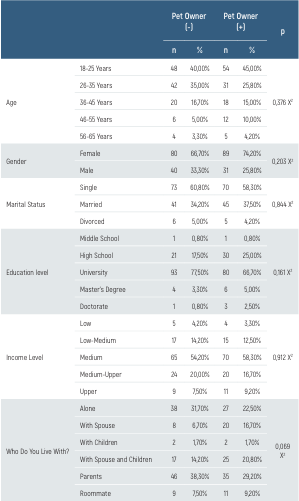
m Mann-whitney u test / X2 Ki-kare test, Med: median; SD: Standard Deviation
Table 2. Comparison of survey results of groups
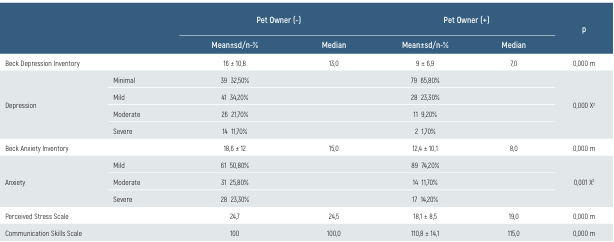
m Mann-whitney u test / X2 Ki-kare test, Med: median; SD: Standard Deviation
Additional Information
Publisher’s Note
Bayrakol MP remains neutral with regard to jurisdictional and institutional claims.
Rights and Permissions

This work is licensed under a Creative Commons Attribution-NonCommercial 4.0 International License (CC BY-NC 4.0). To view a copy of the license, visit https://creativecommons.org/licenses/by-nc/4.0/
About This Article
How to Cite This Article
Büşra İnce, Sena Şahin, Oğuz Öz. Examining the stress, depression, anxiety levels and communication skills of pet owners and non-pet owners. Eu Clin Anal Med 2025;13(1):6-9
- Received:
- July 31, 2024
- Accepted:
- October 14, 2024
- Published Online:
- December 1, 2024
- Printed:
- January 1, 2025