Bibliometric analysis of cancers related to polycystic ovarian syndrome: 1989-2024
Biblıometric analysis of PCOS and cancers
Authors
Abstract
Aim This study aims to investigate the relationship between Polycystic Ovary Syndrome (PCOS) and cancer through bibliometric analysis of scientific publications published between 1989 and 2024.
Methods All scientific studies published between 1989 and 2023 were searched in the Scopus database using the keywords “polycystic ovary syndrome”, “PCOS” and “cancer”. The analyses of the data were conducted utilizing Microsoft Excel 365. Within the scope of quantitative analysis, statistical methods such as frequency distributions, percentages, and averages were used to analyse the data in detail.
Results A total of 8140 documents were published between 1989 and 2023. In 2023, the highest number of PCOS-related cancer documents (n=995) were published. The United States of America, China, Australia, and Northern European countries have made significant contributions to this research area. The researcher with the most publications is R.S. Legro from the United States of America, with 70 publications. The Chinese Ministry of Education stands out as the organization with the highest number of publications, totaling 202. The most common cancers associated with PCOS are endometrial (uterine) cancer, ovarian cancer, breast cancer, and pancreatic cancer.
Conclusion The association of PCOS with various types of cancer may be explained by the hormonal and metabolic dysregulation of this syndrome. The long-term health implications of PCOS, particularly the associated cancer risk, represent a significant area that warrants further research. This study provides the groundwork for future research aimed at understanding the relationship between PCOS and cancer.
Keywords
Introduction
Polycystic Ovary Syndrome (PCOS) is a heterogeneous endocrine- metabolic dysfunction characterized by oligo-ovulation and hyperandrogenism, affecting women’s reproductive functions with a high prevalence (5-10%). Due to its effects on hormone levels, PCOS is also known as ovarian hyperandrogenemia syndrome. PCOS exhibits a variety of clinical symptoms that vary according to the patient’s age. This disorder can present itself from the very early stages of sexual development to old age.1 The diagnostic criteria for PCOS were defined by the National Institutes of Health (NIH) in 1990 and subsequently refined in 2003 by collaboration between the European Society of Human Reproduction and Embryology (ESHRE) and the American Society for Reproductive Medicine (ASRM).2
Typically, the primary reproductive organs in women include the ovaries, fallopian tubes, uterus, and vagina which contain a lifetime supply of ova. These ovums contain structures called follicles. As the ovums mature, the follicles begin to secrete estrogen, a female sex hormone. Once the estrogen level surpasses the threshold concentration, the ovum is released under the influence of luteinizing hormone (LH). The released ovum then passes through the fallopian tube, where fertilization occurs, while the remaining immature follicles disintegrate and dissolve.3 In PCOS, the hormonal imbalance within the menstrual cycle leads to increased secretion of LH by the pituitary gland. Consequently, mature follicles do not form, and ovulation does not occur. Some follicles do not dissolve and form fluid-filled sac-like structures known as cysts. This results in the characteristic appearance of PCOS with multiple follicular structures.4 Additionally, a reduction in apoptosis is observed due to the androgenic effect.5,6 This suggests a close association between PCOS and cancer.
The overall cancer risk encompasses a wide range of factors, including heredity, lifestyle, endocrine therapies, metabolic and dietary components, physical activity, toxic habits, and age. The risk of gynecological cancers in women diagnosed with PCOS is a multifaceted, and yet unresolved matter, shaped by the severity of the condition, treatment approaches, and lifestyle factors.7
PCOS, the most common cause of chronic anovulatory infertility, has recently emerged as a public health issue due to its associated health risks, such as diabetes, dyslipidemia, cardiovascular disease, and cancer.8
Bibliometric analysis is a technique employed to examine and interpret scientific data gathered from multiple studies. Bibliometric analyses are frequently used in studies to measure the performance of articles and journals, assess the competence of leading researchers in the field, identify emerging trends in research components, and understand the intellectual structure of a specific area in the existing literature.9,10 In our study, we aimed to conduct a bibliometric analysis of the literature related to cancer associated with PCOS.
Materials and Methods
Data Source and Search StrategyThe study seeks to explore the potential connection between PCOS and various cancer types by reviewing scientific publications worldwide. In this regard, a search was performed in the Scopus database for all scientific studies published between 1989 and 2023 that included the terms “polycystic ovary syndrome,” “PCOS,” and “cancer” in their titles or abstracts. Since the complete data for 2024 is not available, the analyses were finalized using the data up to 2023, allowing for a more thorough review by assessing all the data avaliable for 2023. The full text query used in the Scopus database search is as follows: “TITLE-ABS-KEY ((polycystic AND ovary AND syndrome) OR (PCOS)) AND (cancer) AND PUBYEAR > 1988 AND PUBYEAR < 2024”.11 The data for the study was gathered by May 2024. The raw data obtained were transferred to Microsoft Excel and processed using Microsoft Excel 365 (Microsoft Corp., Washington, USA) for statistical analysis. For the quantitative analysis of the data, statistical methods such as frequency distributions, percentage values, and means were used. The data underwent both quantitative and qualitative methods, utilizing appropriate bibliometric indicators. The analyses assessed the distribution of publications by year, discipline, publication venue, country, author, institution, document type, and citation frequency.
Ethical ApprovalEthics committee approval is not required for bibliometric analysis.
Statistical AnalysisDescriptive statistical methods were used to evaluate the bibliometric data. The results were summarized using frequencies, percentages, and graphical visualizations.
Reporting GuidelinesThis bibliometric study was reported in accordance with the PRISMA-ScR guidelines.
Results
Distribution of Publications on The Relationship Between Polycystic Ovarian Syndrome and Cancer by YearsThe search results for the period from January 1, 1989, to January 1, 2024, identified a total of 8140 records. These records were examined in detail, and the distribution of publication numbers by year was derived. The number of publications addressing the relationship between PCOS and cancer has significantly increased over the years. While there were only 10 publications in 1989, this number increased to 995 in 2023, indicating an approximately 100-fold increase (Figure 1-a) (R2= 0.9888). From the mid-2000s onwards, a more consistent upward trend in publication numbers has been observed. In particular, the number of documents reached 168 in 2008, showing a 23.53% increase. There were increases of 13.18% and 18.07% in 2012 and 2013, respectively. The rate of increase quickened from the mid-2010s, culminating in 339 documents by 2015. From 2016 to 2018, the number of documents continued to rise steadily, reaching 449, with an average annual growth of 10-15% during this time.
From 2019 to 2021, a much more pronounced increase was observed. In 2019, 562 documents were published, marking a 25.06% increase. This number rose to 634 in 2020, with a 12.82% increase. The most striking increase occurred in 2021, with a 30.70% rise, bringing the number of documents to 828. Finally, the increase in publication numbers continued in 2022 and 2023. In 2022, 960 documents were published, with a 15.94% increase. In 2023, the number reached 995, reflecting a 3.65% increase.
These data clearly demonstrate how interest in the relationship between PCOS and cancer has grown over time and how research activities in this area have intensified. In the past decade, there has been a significant rise in the number of studies focused on this topic, reflecting an increasing interest in exploring the potential connections between PCOS and cancer, both from a clinical and academic perspective.
The Most Publicated Scientists on PCOS and CancerBased on the studies on PCOS and cancer relationship between 1 January 1989 – 1 January 2024 obtained from Scopus database, the number of documents published by the top 10 scientists with the higher number of publications were analyzed, including the proportion of these publications relative to the total, the total citations received, their h-index, and the countries with which these researchers are affiliated. Researchers from the US, China, Australia, the United Kingdom and the Netherlands, in particular, are noted for their significant contributions in this area. This indicates that investigation into the link between PCOS and cancer is gaining importance, with substantial efforts being made globally in this field.
Legro, R. S., from the U. S. is the most widely published researcher on PCOS and its cancer relationship with 70 documents. Legro’s publications have a total of 39.026 citations and have 88 h-indexes. This illustrates Legro’s significant contributions and wide influence in this field. Azziz, R., from the same country, is in second place with 51 publications and has received 35.323 references. Azziz’s 86 h-index indicates that it also has a high level of influence in this area. The fact that these two researchers are from the U. S. suggests that research into PCOS and cancer association is intensifying in the country (Table 1).
Institutions with The Most Publications on The Relationship Between PCOS and CancerBased on the searches conducted in the Scopus database, the universities where the research was conducted, the total number of documents, and the proportions of these numbers within the total records were determined. The institution that contributed the most to the research is the Chinese Ministry of Education, with 202 documents, accounting for 2.48% of the total records. This highlights China’s significant investment and active research activities on the relationship between PCOS and cancer. From Iran, Tehran University of Medical Sciences ranks second with 127 documents (1.56%), showcasing the institution’s intense focus on medical research (Table 2).
The Relationship Between PCOS and Cancer: Distribution by Document TypeStudies exploring the connection between PCOS and cancer have been published in range of document types. Articles are the most frequently published document type in this research area, accounting for a total of 5098 publications. Following articles, review studies account for 2282 publications. Book chapters, numbering 362, are also significant contributors to this field, while 136 conference papers provide important platforms for sharing and discussing research findings. Letters to the editor total 77, and short surveys are used for rapid data collection, with 52 instances. These findings show that research on the connection between PCOS and cancer is disseminated through a wide range of document types, supporting a comprehensive exploration of the topic (Figure 1-b).
Relationship Between PCOS and Cancer by Scientific FieldsMedicine dominates the studies, with 6192 publications representing 50.60% of the total documents. Additionally, the fields of biochemistry, genetics, and molecular biology are notably represented, contributing 3101 studies (25.40%), together making up a significant portion of the overall documents.
In the areas of pharmacology, toxicology, and pharmacy, there are 609 studies (5%), followed by 275 studies in nursing (2.2%), and 291 studies in agricultural and biological sciences (2.4%). The fields of immunology and microbiology account for 240 studies (2%), chemistry for 226 studies (1.8%), neuroscience for 155 studies (1.3%), computer science for 197 studies (1.6%), multidisciplinary fields for 148 studies (1.2%), and chemical engineering for 151 studies (1.2%). Other fields collectively contribute 645 studies (5.3%). These data suggests that study of the relationship between PCOS and cancer encompasses a broad spectrum of scientific disciplines.
Top 10 Countries with The Most Published Documents on The Relationship Between PCOS and CancerAccording to the data, the United States stands out as the leading country in this research area, with 1694 documents, accounting for 20.81% of the total records. China follows closely with 1609 documents, representing 19.77% of the total records. The United Kingdom, India, Iran, Italy, Australia, Turkey, Canada, and Germany follow with 660, 547, 513, 482, 302, 291, 264, and 257 documents, respectively. These countries contribute 8.11%, 6.72%, 6.30%, 5.92%, 3.71%, 3.57%, 3.24%, and 3.16% to the total records, respectively. These data indicate that the relationship between PCOS and cancer has garnered significant global interest, with particularly intense scrutiny from researchers in the United States and China.
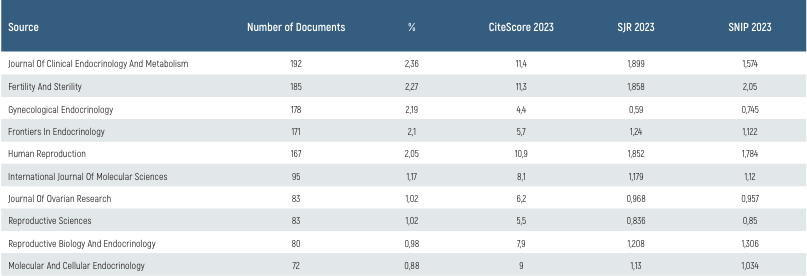
Top 10 Journals Publishing Documents on The Relationship Between PCOS and CancerA search in the Scopus database from January 1, 1989, to January 1, 2024, identified a total of 8140 records related the connection between PCOS and cancer. Analyzing the journals where these studies were published, the top 10 journals and various metrics were evaluated. According to this data, the “Journal of Clinical Endocrinology and Metabolism” ranks first with 192 publications, accounting for 2.36% of all records. It is followed by “Fertility and Sterility” with 185 documents (2.27%) and “Gynecological Endocrinology” with 178 documents (2.19%) (Table 3). These data indicate that research on the relationship between PCOS and cancer is concentrated in certain prominent journals.
Discussion
In this study, the relationship between PCOS and cancer was investigated through bibliometric analysis of scientific publications published between 1989-2024.
Research indicates that PCOS is associated with various cancers, most notably endometrial (uterine) cancer, as well as ovarian cancer, breast cancer, and pancreatic cancer. Endometrial cancer is the most prevalent reproductive malignancy among women, with more than 40,000 cases diagnosed every year in the United States. About 90% of endometrial cancers are estrogen-dependent and exhibit Type I endometrioid patterns, whereas roughly 10% are classified as Type II carcinosarcomas. The link between endometrial cancer and PCOS has received considerable attention in recent years. Research on PCOS often addresses various risk factors, including obesity, diabetes, hypertension, anovulation, nulliparity, and family history.12
Women with PCOS have an approximately 2.7-fold increased risk of developing endometrial cancer, most of which have a good prognosis. The association between PCOS and endometrial cancer is explained by prolonged estrogen exposure due to anovulation, progesterone deficiency, and various genetic abnormalities that control cell proliferation. Both PCOS and ovarian cancer are characterized by higher AMH levels and a greater number of antral follicles. Endometrial hyperplasia poses an oncological risk for patients with PCOS, and women with this condition show an increase in LH hormone receptors.13
The PI3K/Akt/mTOR signaling pathway is involved in the pathogenesis of both PCOS and ovarian cancer, playing a crucial role. mTOR, a serine/ threonine kinase, is key to regulating cell growth, proliferation, and differentiation. The mTOR-mediated signaling system is implicated in the progression of diseases such as type 2 diabetes and cancer. The PI3K/AKT/mTOR signaling pathway functions via phosphorylation, with Akt working directly or indirectly on mTOR. Growth factors such as VEGF and insulin activate cell surface RTKs, which in turn activate Akt. It is now known that the PI3K/AKT signaling pathway is overactive in the endometrium of women with PCOS.14
In PCOS patients exhibiting insulin resistance, elevated levels of androgens, LH, and circulating free testosterone are frequently observed. Increased glucose intake results in hyperinsulinemia, leading to elevated insulin levels. Along with IGF1, this acts on theca cells to release and enhance androgen activity. This can lead to a defect in the glucose metabolism pathway in the endometrium, and the produced IGF1 may cause the proliferation of cancerous cells.15
In obese individuals with insulin resistance, calreticulin levels are high. Calreticulin is also observed to be overexpressed in ovarian cancer. In women with PCOS, elevated levels of the calreticulin precursor have been identified in granulosa cells. There might be a potential link between calreticulin and PCOS.16
Although the literature clearly demonstrating a relationship between PCOS and breast cancer is limited, the prevalence of obesity and its adverse effects on metabolic function suggest the necessity of considering the risk of cancer in ovarian and breast cancers.17
There is no consensus on the standard approach for diagnosing endometrial cancer in women, either through ultrasound or endometrial biopsy. The 3rd PCOS Consensus Workshop Group discussed the necessity of evaluating pathology based on factors such as the length of amenorrhea, endometrial thickness and appearance, abnormal uterine bleeding, and the presence of PCOS.18
Metformin, commonly prescribed for type 2 diabetes, has been reported to assist in regulating menstrual cycles and promoting ovulation in women with PCOS. There is evidence suggesting that metformin treatment may have a protective effect against both endometrial and breast cancer. Letrozole, an aromatase inhibitor used in anovulatory infertility in PCOS, has been suggested to reduce the risk of hormone- dependent breast cancer in postmenopausal women diagnosed with breast cancer.19
Finally, there is insufficient data to evaluate any relationship between PCOS and vaginal, vulvar, cervical cancer, or uterine leiomyosarcoma. Further comprehensive studies are needed to elucidate the relationship between cancer and PCOS.20
Limitations
This study is limited by the use of a single database (Scopus), which may have excluded relevant publications indexed in other databases.
Conclusion
Research on the relationship between PCOS and cancer has increased markedly over time, reflecting growing scientific interest in this topic.
Declarations
Ethics Declarations
The authors confirm that this study was conducted using publicly available bibliometric data and did not involve human participants or patient data.
Animal and Human Rights Statement
All procedures performed in this study were in accordance with the ethical standards of the institutional and/or national research committee and with the 1964 Helsinki Declaration and its later amendments or compareable ethical standards.
Informed Consent
Not applicable.
Data Availability
The data supporting the findings of this article are available from the corresponding author upon reasonable request, due to privacy and ethical restrictions. The corresponding author has committed to share the de-identified data with qualified researchers after confirmation of the necessary ethical or institutional approvals. Requests for data access should be directed to bmp.eqco@gmail.com
Conflict of Interest
The authors declare that there is no conflict of interest.
Funding
None.
Scientific Responsibility Statement
The authors declare that they are responsible for the article’s scientific content including study design, data collection, analysis and interpretation, writing, some of the main line, or all of the preparation and scientific review of the contents and approval of the final version of the article.
References
-
Ng NYH, Jiang G, Cheung LP, et al. Progression of glucose intolerance and cardiometabolic risk factors over a decade in Chinese women with polycystic ovary syndrome: A case- control study. PLoS Med. 2019;16(10):e1002953.
-
Islam H, Masud J, Islam YN, Haque FKM. An update on polycystic ovary syndrome: A review of the current state of knowledge in diagnosis, genetic etiology, and emerging treatment options. Womens Health (Lond). 2022;18:17455057221117966.
-
Yadav S, Delau O, Bonner AJ, et al. Direct economic burden of mental health disorders associated with polycystic ovary syndrome: Systematic review and meta-analysis. Elife. 2023;12:e85338.
-
Mukherjee AG, Wanjari UR, Kannampuzha S, et al. The Implication of mechanistic approaches and the role of the microbiome in polycystic ovary syndrome (PCOS): A review. Metabolites. 2023;13(1):129.
-
Nelson SM, Davis SR, Kalantaridou S, Lumsden MA, Panay N, Anderson RA. Anti-Müllerian hormone for the diagnosis and prediction of menopause: a systematic review. Hum Reprod Update. 2023;29(3):327-346.
-
Zhao H, Zhang J, Cheng X, Nie X, He B. Insulin resistance in polycystic ovary syndrome across various tissues: An updated review of pathogenesis, evaluation, and treatment. J Ovarian Res. 2023;16(1):9.
-
Elgün T. Multidisciplinary Approach to the Polycystic Ovary Syndrome. In: Gok Yurttas A, editor. Novel Targeted Therapeutic Approaches to Cancers. 1nd ed. Turkey: Özgür Press; 2023;p137-152.
-
Hachey LM, Kroger-Jarvis M, Pavlik-Maus T, Leach R. Clinical implications of polycystic ovary syndrome in adolescents. Nurs Womens Health. 2020;24(2):115-126.
-
Donthu N, Kumar S, Mukherjee D, Pandey N, Lim WM. How to conduct a bibliometric analysis: An overview and guidelines. J Bus Res. 2021;133:285-296.
-
Wang YF, Wang MH, Ho YS. A bibliometric analysis of KSHV/HHV8 research. CJSIM. 2020;14:2:219-235.
-
Ekenoglu Merdan Y, Aydoğan O. Publication trends on ınfective endocarditis: Comprehensive bibliometric analysis and visualization between 1892 and 2022. Anatol J Cardiol. 2024;28(5):245–254.
-
Hayes E, Winston N, Stocco C. Molecular crosstalk between insulin-like growth factors and follicle-stimulating hormone in the regulation of granulosa cell function. Reprod Med Biol. 2024;23(1):e12575.
-
Harinee Throwba PK., Unnikrishnan L, Pangath M, Vasudevan K, Jayaraman S, Li M, Iyaswamy A, et al. The epigenetic correlation among ovarian cancer, endometriosis and PCOS: A review. Crit Rev Oncol Hematol. 2022;180:103852.
-
Dumesic DA, Abbott DH, Chazenbalk GD. An Evolutionary Model for the Ancient Origins of Polycystic Ovary Syndrome. J Clin Med. 2023;12(19):6120.
-
Forslund M, Melin J, Stener-Victorin E, Hirschberg AL, Teede H, Vanky E, Piltonen T. International evidence-based guideline on assessment and management of PCOS-A Nordic perspective. Acta Obstet Gynecol Scand. 2024;103(1):7-12.
-
Zou J, Li Y, Liao N, Liu J, Zhang Q, Luo M, et al. Identification of key genes associated with polycystic ovary syndrome (PCOS) and ovarian cancer using an integrated bioinformatics analysis. J Ovarian Res. 2022;15(1):30.
-
Cao R, Chen L, Liu Y, et al. Causal pathways linking polycystic ovary syndrome to distinct breast cancer subtypes through mediator factors: A multivariable mendelian randomization analysis. J Ovarian Res. 2023;16(1):215.
-
Amsterdam ESHRE/ASRM-Sponsored 3rd PCOS Consensus Workshop Group. Consensus on women’s health aspects of polycystic ovary syndrome (PCOS). Hum Reprod. 2012;27(1):14- 24.
-
Sharpe A, Morley LC, Tang T, Norman RJ, Balen AH. Metformin for ovulation induction (excluding gonadotrophins) in women with polycystic ovary syndrome. Cochrane Database Syst Rev. 2019;12(12):CD013505.
-
Jozkowiak M, Piotrowska-Kempisty H, Kobylarek D, et al. Endocrine disrupting chemicals in polycystic ovary syndrome: The relevant role of the theca and granulosa cells in the pathogenesis of the ovarian dysfunction. Cells. 2022;12(1):174.
Figures
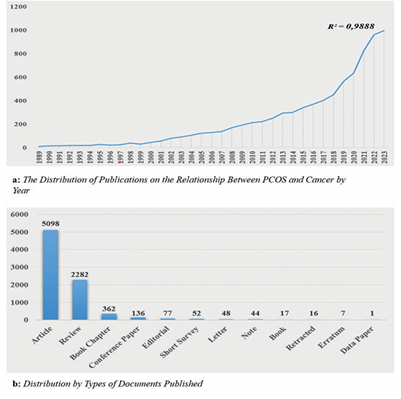
Figure 1. a: The Distribution of Publications on the Relationship Between PCOS and Cancer by Year; b: Distribution by Types of Documents Published
Tables
Table 1. Top 10 Authors Who Published the Most
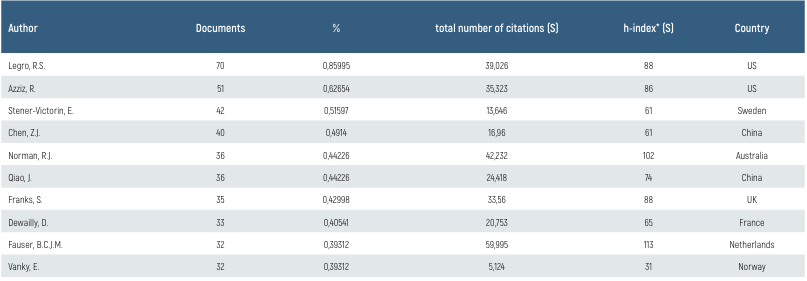
Table 2. Top 10 Institutions with the Most Publications on the Relationship between PCOS and Cancer
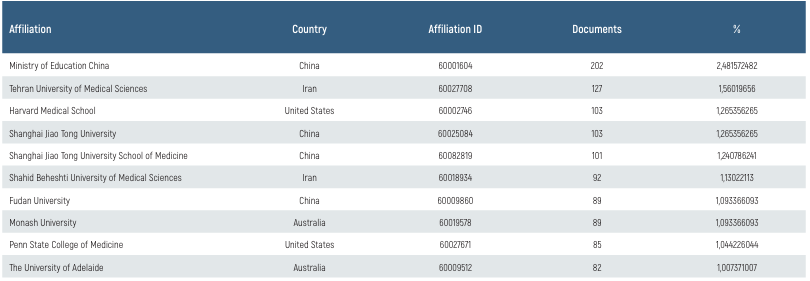
Table 3. Top 10 Journals with the highest number of documents on the relationship between PCOS and cancer
Additional Information
Publisher’s Note
Bayrakol MP remains neutral with regard to jurisdictional and institutional claims.
Rights and Permissions

This work is licensed under a Creative Commons Attribution-NonCommercial 4.0 International License (CC BY-NC 4.0). To view a copy of the license, visit https://creativecommons.org/licenses/by-nc/4.0/
About This Article
How to Cite This Article
Tugba Elgun, Halil Ibrahim Arslan, Kaan Zıksahna. Bibliometric analysıs of cancers related to polycystıc ovarian syndrome: 1989-2024. Eu Clin Anal Med 2024;12(3):41-45
- Received:
- May 8, 2024
- Accepted:
- August 30, 2024
- Published Online:
- August 31, 2024
- Printed:
- September 1, 2024