Evaluation of the accuracy and quality of YouTube videos as an information source on septic arthritis
Accuracy and quality of YouTube videos on septic arthritis
Authors
Abstract
Aim Septic arthritis is a time-sensitive surgical emergency with high morbidity and mortality if not promptly managed. As patients increasingly turn to online platforms such as YouTube for health information, the quality and reliability of such content warrant investigation, and this study assessed the educational quality of YouTube videos on septic arthritis using the DISCERN instrument, Global Quality Score (GQS), Journal of the American Medical Association (JAMA) Benchmark Criteria, and Video Power Index (VPI).
Methods A YouTube search was conducted in July 2025 using the keyword “septic arthritis.” Fifty English-language videos longer than 60 seconds were evaluated. Two independent reviewers—a board-certified orthopedic surgeon and an infectious disease/microbiology specialist—assessed each video using the tools above. Statistical analyses included Kruskal-Wallis, Mann-Whitney U, and Spearman correlation tests.
Results The videos garnered 3,362,470 total views (mean per video: 67,249). Only 1 out of 50 videos (2%) achieved an excellent DISCERN score, while 35 out of 50 videos (70%) were rated very poor. GQS analysis showed 86% of videos as poor or very poor, with none rated excellent. Physician-uploaded videos had significantly higher DISCERN (median 46.8), GQS (median 4.2), and JAMA scores (median 3.1) compared to commercial and patient- uploaded content (p<0.001). VPI scores did not differ significantly between uploader types. Interobserver agreement was strong, with Krippendorff’s alpha values ranging from 0.78 to 0.86 across the scoring tools.
Conclusion Most YouTube videos on septic arthritis provide suboptimal educational value, particularly those from non-professional sources. Greater involvement by healthcare professionals in digital content creation is critical to combat misinformation.
Keywords
Introduction
Septic arthritis is a severe surgical condition that requires immediate treatment. Despite rapid surgery and effective antibiotic agents, the mortality and morbidity rates remain high 1,2. If not treated promptly, it can lead to serious joint damage and systemic complications. The most common causative agent continues to be Staphylococcus aureus. The annual incidence in Europe is 4-10 per 100,000 patients 3,4. This topic, which is commonly encountered in medical textbooks or clinical practice, has begun to appear more frequently on public online platforms such as YouTube. YouTube is one of the most-watched video- sharing sites and reaches millions of people every day 5.
Previous evaluations of YouTube content for various medical conditions have consistently revealed substantial variability in accuracy and completeness 5,6. For instance, musculoskeletal and surgical procedure videos often score poorly on established quality metrics, particularly when produced by lay or commercial sources. Patients frequently consult these digital platforms for medical guidance; however, the absence of rigorous editorial oversight raises serious concerns regarding content reliability. Given the acute and potentially debilitating nature of septic arthritis, dissemination of inaccurate or misleading information may delay critical care and exacerbate patient outcomes. Accordingly, this study systematically evaluates the educational quality of YouTube videos on septic arthritis using the validated DISCERN instrument, Global Quality Score (GQS), JAMA Benchmark Criteria, and Video Power Index (VPI).
Materials and Methods
• Search strategy: A YouTube (https://www.youtube.com) search was conducted in July 2025 using the keyword “septic arthritis.”
• Inclusion criteria:
o English-language videos
o Duration >60 seconds
o Focused on septic arthritis in any joint
o Non-duplicate, evaluable quality
• Exclusion criteria:
o Irrelevant or entertainment-based content
o Non-medical commentary or satire
o Poor audio-visual resolution
• Data collection parameters:
o Video title, duration, views, likes, likes ratio, comments, upload date
o Uploader classification: Physician, Institution, Patient, Commercial,
Other
o Assessment scores:
· DISCERN: The DISCERN instrument is a validated 16-item questionnaire
assessing clarity, reliability, bias, and support for shared decision- making. It uses a 5-point scale (1 = poor quality, 5 = high quality). The total score ranges from 16 to 80, with higher scores indicating superior
educational content 7.
· Global Quality Score (GQS): The GQS is a simple 5-point Likert scale evaluating the overall quality, flow, and usefulness of video content. Scores range from 1 (poor) to 5 (excellent)8.
· The Journal of the American Medical Association (JAMA) Benchmark Criteria: This tool assesses four key domains—authorship, attribution, disclosure, and currency—each scored as 1 (present) or 0 (absent), for a maximum total score of 4 9.
· Video Power Index (VPI): A composite metric reflecting video popularity and audience approval. It considers both the like ratio and view rate to provide a dynamic measure of video impact. Previous studies have successfully used VPI to assess the influence of YouTube content in medical education and patient information 6.
· Like Ratio: The like ratio was calculated using the formula: Like Ratio = (Number of Likes) ÷ (Number of Likes + Number of Dislikes)
× 100, providing a percentage representation of positive audience engagement6. Interobserver reliability was calculated using the intraclass correlation coefficient (ICC).
Evaluation and analysis: An orthopedic surgeon and an infectious disease and microbiology specialist independently reviewed all videos. Statistical analysis
For statistical analysis, IBM SPSS Statistics version 23.0 (IBM Corp., Armonk, NY, USA) was used. The distribution of continuous variables was assessed with the Shapiro-Wilk test, skewness and kurtosis, and histogram plots. Non-normally distributed variables were reported as median (IQR) and categorical variables as frequency (percentage). Group comparisons were performed using Kruskal-Wallis and Mann- Whitney U tests. Relationships between continuous variables were analyzed using Spearman’s correlation. Correlation strength was classified as very weak (<0.2), weak (0.2–0.4), moderate (0.4–0.6), high (0.6–0.8), and very high (>0.8). Interobserver reliability for DISCERN, GQS, JAMA, and VPI was evaluated using Krippendorff’s alpha (α), with α<0.67 classified as weak, 0.67≤α<0.80 moderate, and α≥0.80 excellent. Statistical significance was set at p<0.05.
Ethical approval• Search strategy: A YouTube (https://www.youtube.com) search was conducted in July 2025 using the keyword “septic arthritis.”
• Inclusion criteria:
o English-language videos
o Duration >60 seconds
o Focused on septic arthritis in any joint
o Non-duplicate, evaluable quality
• Exclusion criteria:
o Irrelevant or entertainment-based content
o Non-medical commentary or satire
o Poor audio-visual resolution
• Data collection parameters:
o Video title, duration, views, likes, likes ratio, comments, upload date
o Uploader classification: Physician, Institution, Patient, Commercial,
Other
o Assessment scores:
· DISCERN: The DISCERN instrument is a validated 16-item questionnaire
assessing clarity, reliability, bias, and support for shared decision- making. It uses a 5-point scale (1 = poor quality, 5 = high quality). The total score ranges from 16 to 80, with higher scores indicating superior
educational content 7.
· Global Quality Score (GQS): The GQS is a simple 5-point Likert scale evaluating the overall quality, flow, and usefulness of video content. Scores range from 1 (poor) to 5 (excellent)8.
· The Journal of the American Medical Association (JAMA) Benchmark Criteria: This tool assesses four key domains—authorship, attribution, disclosure, and currency—each scored as 1 (present) or 0 (absent), for a maximum total score of 4 9.
· Video Power Index (VPI): A composite metric reflecting video popularity and audience approval. It considers both the like ratio and view rate to provide a dynamic measure of video impact. Previous studies have successfully used VPI to assess the influence of YouTube content in
medical education and patient information 6.
· Like Ratio: The like ratio was calculated using the formula: Like Ratio = (Number of Likes) ÷ (Number of Likes + Number of Dislikes)
× 100, providing a percentage representation of positive audience engagement6. Interobserver reliability was calculated using the intraclass correlation coefficient (ICC).
Evaluation and analysis: An orthopedic surgeon and an infectious disease and microbiology specialist independently reviewed all videos.
Ethical ApprovalThis study analyzed publicly available YouTube videos and did not involve human participants or animal subjects. Therefore, formal ethical approval was not required.
Statistical AnalysisFor statistical analysis, IBM SPSS Statistics version 23.0 (IBM Corp., Armonk, NY, USA) was used. The distribution of continuous variables was assessed with the Shapiro-Wilk test, skewness and kurtosis, and histogram plots. Non-normally distributed variables were reported as median (IQR) and categorical variables as frequency (percentage). Group comparisons were performed using Kruskal-Wallis and Mann- Whitney U tests. Relationships between continuous variables were analyzed using Spearman’s correlation. Correlation strength was classified as very weak (<0.2), weak (0.2–0.4), moderate (0.4–0.6), high (0.6–0.8), and very high (>0.8). Interobserver reliability for DISCERN, GQS, JAMA, and VPI was evaluated using Krippendorff’s alpha (α), with α<0.67 classified as weak, 0.67≤α<0.80 moderate, and α≥0.80 excellent. Statistical significance was set at p<0.05.
Reporting GuidelinesThis study was reported in accordance with the STROBE guidelines.
Results
A total of 50 YouTube videos on septic arthritis were included in this study, cumulatively generating 3,362,470 views (range: 1,548–1,581,639). The mean number of views per video was 67,249 (SD=189,620). The average time since upload was 73 months (SD=48), and the median video length was 8.2 minutes (IQR: 4.5–15.3). The mean daily view ratio was 27.51 (SD=61.99). Each video received a mean of 30 comments (SD=94), with an annual comment rate of 9.16 per video. Due to the removal of public dislike counts on YouTube, many videos displayed a like ratio of 100%. However, this ratio may overestimate viewer approval, especially considering that only 0.4% of viewers engaged by liking the videos. This metric was interpreted with caution given platform limitations. This metric was interpreted with caution given platform limitations (Table 1). Quality assessment: Analysis using four validated tools—DISCERN, GQS, JAMA Benchmark, and VPI—revealed significant variability in content quality. Based on DISCERN scores, 1 video (2%) was rated excellent, 3 (6%) good, 3 (6%) fair, 8 (16%) poor, and 35 (70%) very poor. GQS revealed
no excellent videos, 4 (8%) good, 3 (6%) fair, 23 (46%) poor, and 20 (40%) very poor. The mean VPI score was 345.7 (SD=178.2), indicating moderate audience engagement overall.
Subgroup analyses: Among the 50 videos, 38 (76%) were non-animated and 12 (24%) were animated. Non-animated videos demonstrated higher median scores across DISCERN (32.5 vs. 28.3), GQS (3.1 vs. 2.5), JAMA (2.1 vs. 1.7), VPI (362.4 vs. 319.7), and view ratios. However, these differences were not statistically significant (p > 0.05).
Regarding uploader type, 38 videos (76%) were shared by physicians, 2 (4%) by other healthcare professionals, 8 (16%) by commercial sources, and 2 (4%) by patients. Physician-uploaded videos had significantly higher median DISCERN (46.8, IQR: 42.1–52.4), GQS (4.2, IQR: 3.7–4.8),
and JAMA scores (3.1, IQR: 2.7–3.9) compared to commercial (DISCERN median 27.6) and patient-uploaded videos (DISCERN median 24.5) (p < 0.001). VPI and view ratios, however, did not significantly differ between uploader groups (p > 0.05). (Table 2)
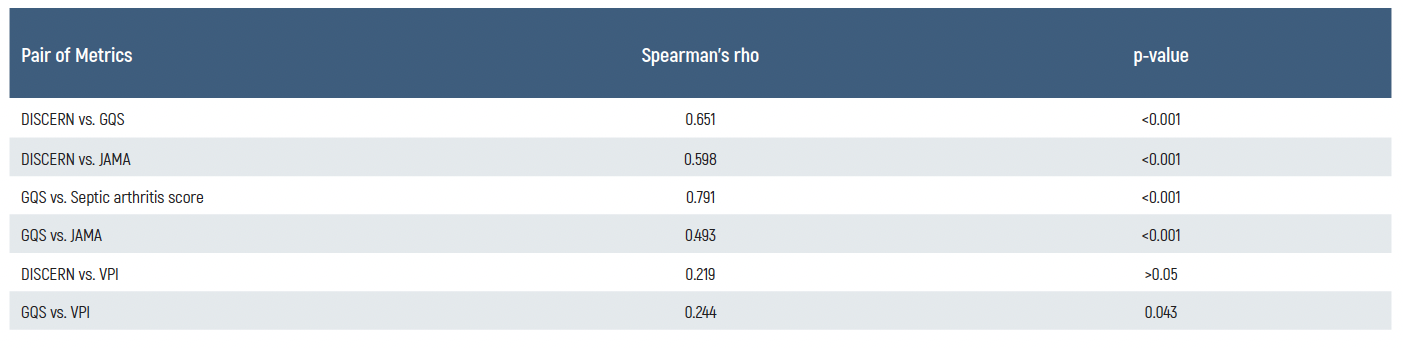
Correlation analysis: Spearman correlation analysis showed strong positive correlations between GQS and the septic arthritis-specific score (rho=0.791, p<0.001), GQS and JAMA (rho=0.493, p<0.001), and GQS and DISCERN (rho=0.651, p<0.001). There was no significant correlation between total view count and any of the educational quality metrics (p>0.05), emphasizing that high popularity does not necessarily indicate superior quality (Table 3).
Discussion
This study provides a robust and multidimensional evaluation of the educational quality, reliability, and engagement potential of YouTube videos concerning septic arthritis. Septic arthritis remains a critical clinical condition, with rapid progression leading to joint destruction and sepsis if early diagnosis and management are not achieved 10,11. In the era of digital information, patients and caregivers increasingly rely on online platforms for medical knowledge, but our findings expose the significant shortcomings of current YouTube content in addressing this need.
Our results revealed that only 2% of videos achieved an excellent DISCERN score, while a striking 70% were rated very poor. Similarly, GQS analysis identified no excellent videos, with 86% classified as poor or very poor. These figures highlight a concerning predominance of low-quality content and align with prior studies showing similar trends in orthopedic and infectious disease-related videos 12. The mean VPI score of 345.7 further underscores moderate audience engagement, suggesting that even popular videos may not meet educational standards.
Higher DISCERN, GQS, and JAMA scores in physician and institution uploaded videos underscore the value of expert-led content. Professional involvement ensures accuracy and can support early recognition and treatment of septic arthritis, critical for preventing irreversible morbidity. However, the lack of significant differences in VPI and view ratios between professional and non-professional sources suggests that algorithm-driven engagement favors entertainment or accessibility over educational rigor.
Although videos without animation had higher average quality scores, there was no significant difference in VPI and viewing rates between animated and non-animated content. This is in line with the observations made by Cassidy et al. and shows that although animations can attract viewers’ attention thanks to their visual appeal, they do not automatically increase educational accuracy unless they are developed under medical supervision 13.
The absence of a significant correlation between total view counts and quality metrics is particularly noteworthy. Similarly, a study conducted in 2023 argued that YouTube’s algorithm prioritizes engagement over scientific accuracy and disseminates content based on its popularity rather than its educational value 14. This trend raises concerns about the potential spread of misinformation, particularly in time-sensitive conditions like septic arthritis.
Gaps in the analyzed content were evident, with many videos lacking comprehensive information about post-operative care, indications for surgical intervention, risk factors, and potential complications. Such shortcomings are not unique to septic arthritis videos; Uzel et al. found that trigger finger videos on YouTube had mean JAMA and DISCERN scores of just 2 and 36, respectively, classifying about 68 % as low quality, while Albayrak and Büyükçavuş reported that only 14 % of orthognathic surgery videos provided rich educational content despite high interaction levels 15,16,17,18. Given the morbidity and mortality associated with delayed or mismanaged septic arthritis, these omissions represent a critical barrier to patient education.
Limitations
A major strength of this study lies in its multidimensional evaluation using four validated scoring systems, providing a holistic perspective on video quality and engagement. Additionally, the use of Krippendorff’s alpha ensured robust interobserver reliability.
However, this study has limitations inherent to cross-sectional designs.
YouTube’s dynamic nature means that video popularity metrics and content can change rapidly, potentially altering educational quality over time. Our analysis was restricted to English-language videos, which may not reflect global trends. Furthermore, the subjective elements of the DISCERN and GQS instruments, despite being mitigated by independent reviewers, may introduce a degree of evaluator bias.
Conclusion
YouTube has become one of the most widely accessed platforms for health-related information. However, our study demonstrates that videos on septic arthritis are largely of poor educational quality, with significant gaps in critical content. To address this issue, healthcare professionals should take an active role in producing and disseminating accurate, evidence-based medical content online. Furthermore, the development of peer-reviewed video libraries can serve as a reliable resource for patients, potentially improving understanding, engagement, and clinical outcomes in time-sensitive conditions such as septic arthritis.
Declarations
Ethics Declarations
This study was conducted in accordance with accepted principles for research involving publicly available data.
Animal and Human Rights Statement
All procedures performed in this study were in accordance with the ethical standards of the institutional and/or national research committee and with the 1964 Helsinki Declaration and its later amendments or compareable ethical standards.
Informed Consent
Not applicable. This study analyzed publicly available online videos and did not involve human participants.
Data Availability
The datasets generated and analyzed during the current study are available from the corresponding author on reasonable request.
Conflict of Interest
The authors declare that there is no conflict of interest.
Funding
None.
Scientific Responsibility Statement
The authors declare that they are responsible for the article’s scientific content including study design, data collection, analysis and interpretation, writing, some of the main line, or all of the preparation and scientific review of the contents and approval of the final version of the article.
Abbreviations
DISCERN: Quality assessment instrument for written consumer health information
GQS: Global Quality Score
ICC: Intraclass Correlation Coefficient
IQR: Interquartile Range
JAMA: Journal of the American Medical Association Benchmark Criteria
SD: Standard Deviation
VPI: Video Power Index
References
-
He M, Vithran DTA, Pan L, et al. An update on recent progress of the epidemiology, etiology, diagnosis, and treatment of acute septic arthritis: A review. Front Cell Infect Microbiol. 2023;13:1193645.
-
Alexandersson H, Dehlin M, Jin T. Increased incidence and clinical features of septic arthritis in patients aged 80 years and above: A comparative analysis with younger cohorts. Pathogens. 2024;13(10):891.
-
Singh JA, Yu S. The burden of septic arthritis on the U.S. inpatient care: A national study. PLoS One. 2017;12(8):e0182577.
-
Donell S. Why do we not prescribe steroids in acute native septic arthritis? Knee Surg Sports Traumatol Arthrosc. 2020;28(5):1343-1345.
-
Bayram Y, Pınar E. Assessment of the quality and reliability of YouTube as an information source for transforaminal interbody fusion. Cureus. 2023;15(12):e50210.
-
Erdem MN, Karaca S. Evaluating the accuracy and quality of the information in kyphosis videos shared on YouTube. Spine (Phila Pa 1976). 2018;43(22):E1334-9.
-
Mert A, Bozgeyik B. Quality and Content Analysis of Carpal Tunnel Videos on YouTube. Indian J Orthop. 2021;56(1):73-78.
-
Karagoz B, Bakir M, Kececi T. Evaluation of the accuracy and quality of information in videos about lateral epicondylitis shared on internet video sharing services. Cureus. 2022;14(2):e22583.
-
McMahon KM, Schwartz J, Nilles-Melchert T, et al. YouTube and the Achilles Tendon: An Analysis of Internet Information Reliability and Content Quality. Cureus. 2022;14(4):e23984
-
Mathews CJ, Weston VC, Jones A, Field M, Coakley G. Bacterial septic arthritis in adults. Lancet. 2010;375(9717):846-855.
-
Margaretten ME, Kohlwes J, Moore D, Bent S. Does this adult patient have septic arthritis? JAMA. 2007;297(13):1478-1488.
-
Osman W, Mohamed F, Elhassan M, Shoufan A. Is YouTube a reliable source of health- related information? A systematic review. BMC Med Educ. 2022;22(1):382.
-
Cassidy JT, Fitzgerald E, Cassidy ES, et al. YouTube provides poor information regarding anterior cruciate ligament injury and reconstruction. Knee Surg Sports Traumatol Arthrosc. 2018;26(3):840-845.
-
Ng YMM, Hoffmann Pham K, Luengo-Oroz M. Exploring YouTube’s recommendation system in the context of COVID-19 vaccines: computational and comparative analysis of video trajectories. J Med Internet Res. 2023;25:e49061.
-
Starks C, Akkera M, Shalaby M, et al. Evaluation of YouTube videos as a patient education source for novel surgical techniques in thyroid surgery. Gland Surg. 2021;10(2):697-705.
-
Desai T, Shariff A, Dhingra V, Minhas D, Eure M, Kats M. Is content really king? An objective analysis of the public’s response to medical videos on YouTube. PLoS One. 2013;8(12):e82469.
-
Uzel K, Yilmaz MK, Cacan MA, Artuc M. Quality and Reliability of Trigger Finger YouTube Videos. Muscles, Ligaments and Tendons Journal. 2023;13(3):463-468.
-
Albayrak E, Büyükçavuş MH. Does YouTube offer high-quality ınformation? Evaluation of patient experience videos after orthognathic surgery. Angle Orthod. 2023;93(4):409-416.
Tables
Table 1
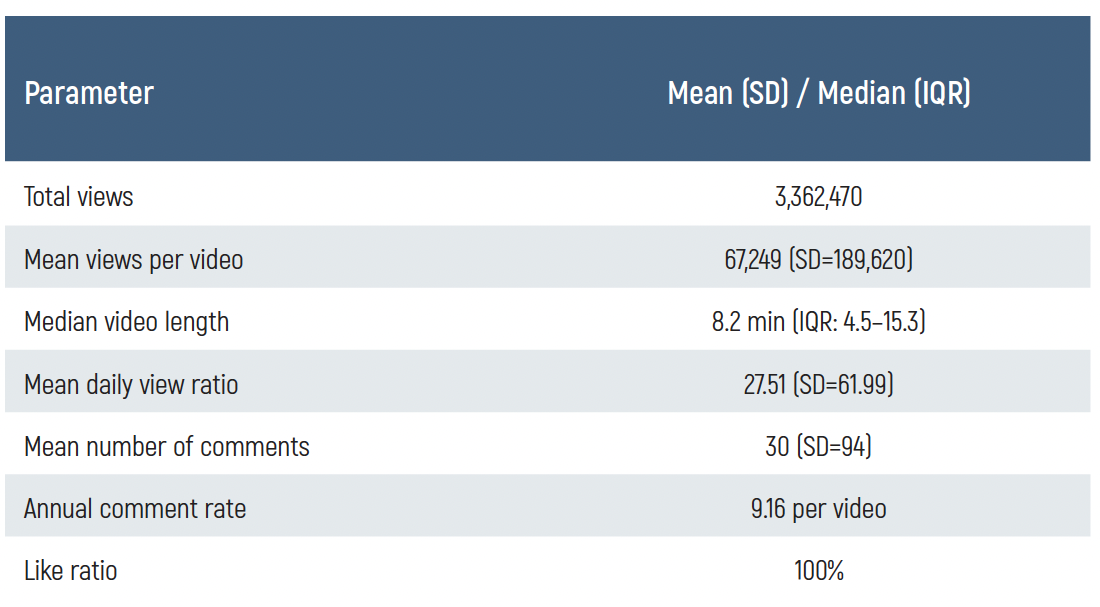
Table 2
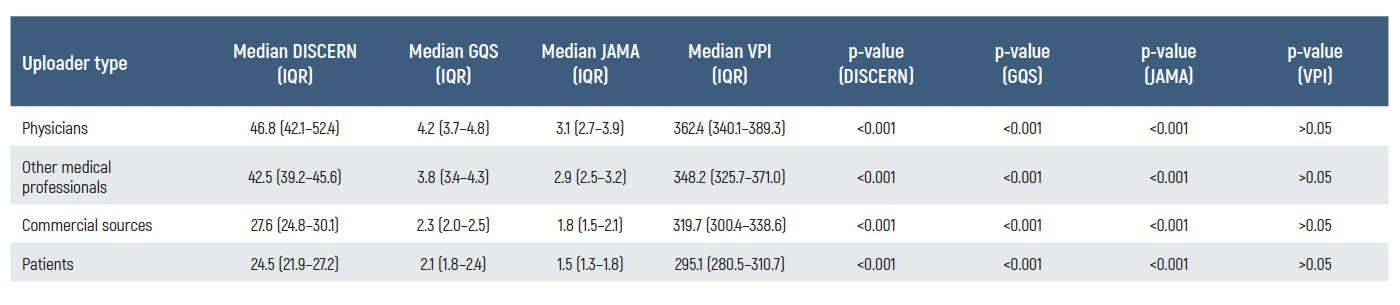
Table 3
Additional Information
Publisher’s Note
Bayrakol MP remains neutral with regard to jurisdictional and institutional claims.
Rights and Permissions

This work is licensed under a Creative Commons Attribution-NonCommercial 4.0 International License (CC BY-NC 4.0). To view a copy of the license, visit https://creativecommons.org/licenses/by-nc/4.0/
About This Article
How to Cite This Article
Muhammed Enes Karatas, Betül Yıldız Karatas. Evaluation of the accuracy and quality of YouTube videos as an information source on septic arthritis. Eu Clin Anal Med 2025;13(3):66-69
Publication History
- Received:
- July 8, 2025
- Accepted:
- August 8, 2025
- Published Online:
- August 30, 2025
- Printed:
- September 1, 2025