
Abstract
AimHaving multiple disabled child is stressful for parents because they continue to carry out demanding care procedures in everywhere. In this context, we planned to investigate the health conditions and problems of the families with quantitative method.MethodsThe universe of the study consists of the families of 10 disabled children registered in Counseling and Research Center affiliated with Muğla Provincial Directorate of National Education in Türkiye. No sampling was executed in this study, and 10 parents accepting to participate into the study voluntarily were involved. An exploratory, qualitative study was conducted, including individual interviews with parents focus groups.Results‘‘Concerns for the child’s well-being” was central for the parents and focussed on the areas of their “Development”. They devoted themselves entirely to their children. Even his illnesses were focused for their children. They are protecting their children, but sometimes they are feeling burnout themselves. They did not think their health, also they did not think even could do something for their health.ConclusionParents work hard to safeguard the well-being of their disable child first. And of course, they need professionals care sometimes. Becuse, still they do not know, how will live their own lifes.
Keywords
Introduction
One in ~68 children in the United States suffers from autism spectrum disorder (ASD), which is a highly-heritable neurodevelopmental mental condition characterized by difficulty in communicating, forming relationships with other individuals, using language and manipulating abstract concepts.1 Cerebral palsy (CP) is one of the most common physical disabilities, affecting approximately 2–3/1000 children.2 Diasbility is a special condition, for everyone. Although the World Health Organization describes people with disability as among the most marginalised and vulnerable populations in the world.3 If they are special, children with disabilities require health and other related services beyond that required by normal children in order for them to be individually planned or coordinated. A caregiver is defined as the parent (either mother or father) or other family members (grandmother or grandfather, siblings, aunt or uncle and adoptive parent) of the disabled child who is responsible of parenting or caring for the disabled child. A caregiver provides practical, day-to-day unpaid support for a person unable to complete all of the tasks of daily living.4 The implications of caring for a child with disability are considerable and can have profound effects on the entire family who are parents, siblings, and extended family members. But, providing the high-quality care that is required by a child with long-term functional limitations may impact the health and quality of life (QOL) of the caregivers.5 And, we want to determine severe conditions whose havıng disabled children families’ health conditions in Muğla, in Türkiye.
Materials and Methods
A qualitative research design using open-ended, semi-structured, indepth interviews was chosen to provide the experiences of disability children’ parents. The universe of the study consists of the families of 10 disabled children registered in Counseling and Research Center affiliated with Muğla Provincial Directorate of National Education in Türkiye. Written approval for the study was obtained from the Muğla Sıtkı Koçman University (Muğla, Türkiye) Ethics Committee. All participants families were informed by the researcher about the aims of the study, and verbal informed consent was obtained for participation. We told the participants families that they could withdraw from the study at any time and that all information would be kept strictly confidential. The design of the study was informed by the researcher, 5 semi-structured, in-depth interviews were conducted to enable the participants to delve deeper into topics that they considered to be important in a flexible and iterative process. We, record whole conversation with a video-recorder. And, after conversation whole words was written on the paper.
Therefore, the research questions for this study were:
1.Who are you? Introduce yourself, please
2.Have you got an illness or chronic diseases?
3.What are you doing for being more healthfull?
4.Do your health is being affected to have a disable children?
5.What can you do to solve your problems?
Results
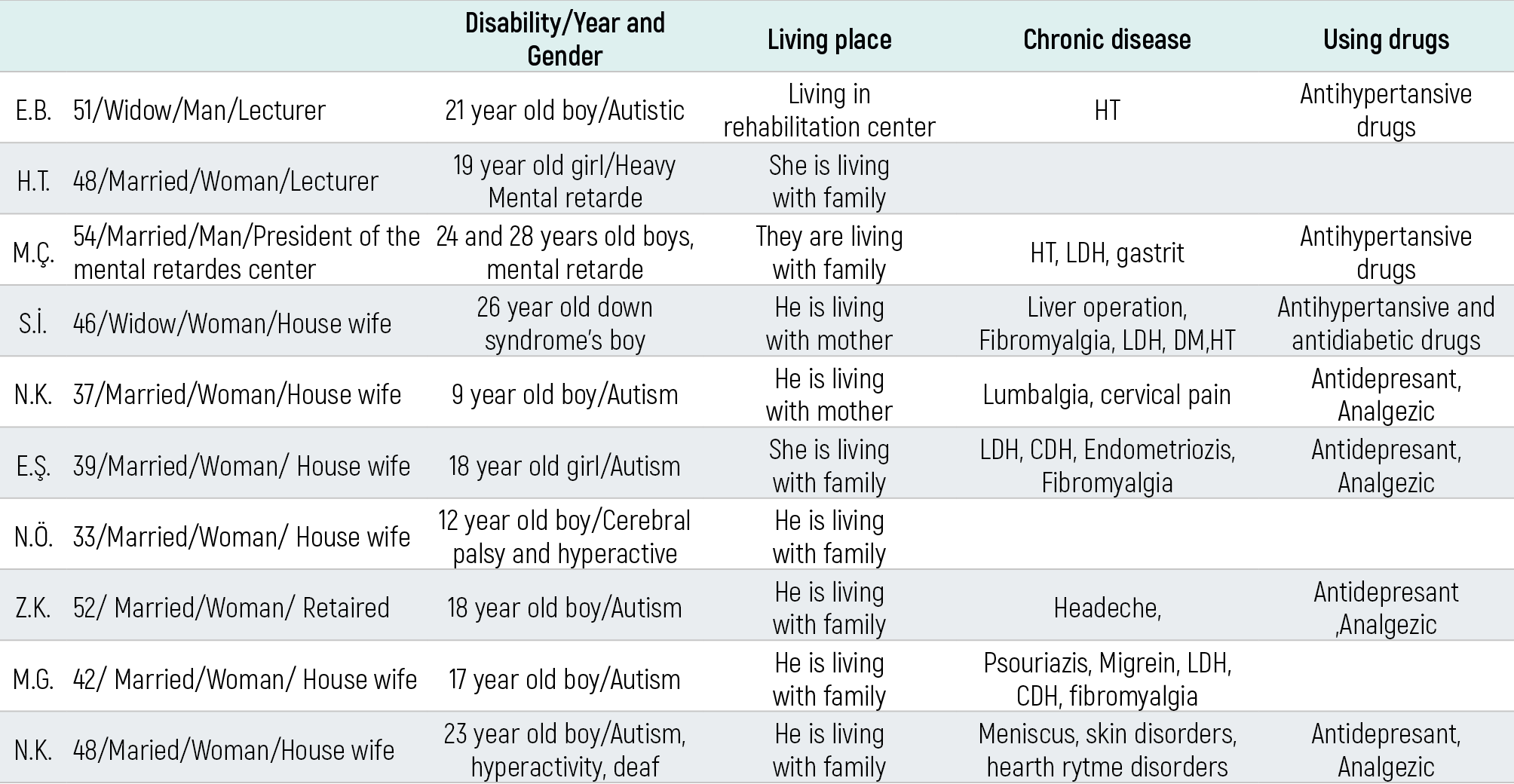
ThemesDiscussions associated with thise themes garnered the greatest number and most emotional responses. All parents described lives filled with multiple and complex demands relating to raising children with a physical disability, with most describing physically and emotionally experiences. Parents described their feelings:Having Disabled Child Influences LivesParents diseases were shown in Table 1. Nearly all parents has got, lumbal disc hernias(LDH), cervical disc hernias (CDH), migraine, fibromyalgia. And parents have been used antidepressants in their life parts. And some of them are stil using.Life Dedicated to ChildrenI have never spent my time in the name of healthy life, now I think (N.K/23 year old boy).I liked to walk with my son until 2 years ago, I liked to ride the bike, but now I feel very tired myself, I feel my strength is running out (Z.K/18 year old boy). This happens reduces the quality of life, that is, I am speaking here (by showing the area of the shoulder by hand), pounding a knife here as if it is a knife (E.Ş/18 year old girl).So we think, what is healthy life (Whole of them)Family caregiving of their loved ones can be a satisfying and joyful experience. Despite these satisfying outcomes, a main concern has been about the family carer’s health and well-being in general. Family caregiving is known to be a formidable task that is highly emotional and burdensome, and requires timeless commitment and effortsLives Filled With Complex and Multiple DemandsWhile we are dealing with children with disabilities, there are a lot of people on the streets too, so we are not the only ones suffering (H.T/19 year old girl).In fact no one is in a exellent life (E.B/21 year old boy).Parents spoke of their grief, despair, sadness, and guilt regarding their children’s (Whole of them)Taking him into many public places is a challenge and we have a lot of stress due to difficult or aggresive behaviors,’’ and then finish the sentence by saying, ‘‘but (we) love him and cannot imagine life without him.(Z.D and N.Ö/23 and 12 years old boys)Trying to understanding the difficulties and needs of the families in giving care of their children’ with some disabilities and thinking their caring capacity and to continue their diffucult caring roles. In this study we saw to explore family caregiving experiences while they have to provide children’ and own life care for themselves and their ageing children with mild or moderate disabilities. We also, saw, if you have a problem in your life, you find your life way differently. Your quality of life ranked with serious disabilities as ‘good’ or ‘excellent’ and you can feel yourself hopefull. Because, you are the same chance with each people.It is important.Relationships: Consistency, Communication and CaringThere is an incredible fatigue in the human body and you can not tolerate it anymore and you feel tired at that point a little bit of support is actually not the point we need support (N.K./9 year old boy).They do not understand what we are suffering from (E.B/21 year old boy).For instance, my son, 23 years old, and when he gets pee, I took him into the women’s toilet, People look us and they told something us, they do not understand (Z.K./23 age year boy)For example, mental retardate child parent’ did not know clearly what we would want. Will we want a kilogram of educations? (N.Ö/12 year old boy).You always think negative, but you are trying to positively influence yourself, you are physically and mentally very difficult to feel it, we are fighting a lot to accept it (N.K/ 23 year old boy).Even at night, you do not have a chance to rest (S.I/26 year old boy).Parents commonly say they need a supportive care and have identifieda need for such a service or hospice care in the home or somewhere. This study sought to explore the needs and changes in the everyday life of families with children suffering from varying severity disability, and with mental disability. Especially, important to determine the health problems and parents problems with disabled child, because, if continuity of care and competence are ensured, for instance if it is provided by someones, famillies life will change immediatelly.
Discussion
Finding out that your child is disabled is a traumatic event for the family no matter what the degree of disability could be. A disabled child is dependent on their parents on varying degrees. This is a significant source of stress for the family. In the literature it is reported that psychological problems are more commonly seen among mothers with disabled children compared to mothers who do not have disabled children.5-8 Also, some evidence showed that families of disabled children face greater financial burdens than families who have non-disabled children.9 Providing the basic necessities for these children is costly and places financial pressure on parents. Parents of children with disability were reported to have financial burden and difficulty in maintaining their employment, which in turn affect their. Social support can be provided informally such as by family, friends, neighbours and wider community, and formally such as by professionals and agencies. Both formal and informal supports are important to relieve parents’ stress.10 Social support also can include emotional support and practical support like helping to take care of the child and providing financial assistance. A qualitative study revealed stress is the most frequent theme that arises in the parents’ accounts of how their child with disability has affected their families’ lives.11 And also, parental stress can also affect the psychological well-being.12 Raising a child with disability is stressful for parents and families. In addition to having difficulties in social interactions and communication, hard to manage chaos throughout the household. And families adopted their lives fort hem. They, do not take care of themselves and no time to rest. The mix of negative and positive themes are interpreted in light of a dialectical viewpoint of finding positive meaning to life even while acknowledging the difficulties of having a child in disabilities.
Declarations
Animal and Human Rights Statement
This study was approved by the Muğla Sıtkı Koçman University Ethics Committee and conducted in accordance with ethical standards.
Informed Consent
Verbal informed consent was obtained from all participants.
Conflict of Interest
The authors declare no conflicts of interest.
Funding
None.
References
- Irimia A, Torgerson CM, Jacokes JZ, Van Horn JD. The connectomes of males and females with autism spectrum disorder have significantly different white matter connectivity densities. Sci Rep. 2017;7:46401. doi:10.1038/srep46401
- Lindsay S. Child and youth experiences and perspectives of cerebral palsy: a qualitative systematic review. Child Care Health Dev. 2016;42(2):153-175. doi:10.1111/cch.12309
- Greenstein C, Lowell A, Thomas D. Communication and context are important to Indigenous children with physical disability and their carers at a community-based physiotherapy service: a qualitative study. Physiotherapy. 2016;62:42-47. doi:10.1016/j.jphys.2015.08.010
- Isa I, Ishak I, Ab Rahman A, et al. Health and quality of life among the caregivers of children with disabilities: a review of literature. Asian J Psychiatr. 2016;23:71-77. doi:10.1016/j.ajp.2016.07.007
- Davis E, Shelly A, Waters E, et al. The impact of caring for a child with cerebral palsy: quality of life for mothers and fathers. Child Care Health Dev. 2009;36(1):63-73.
- Paule Low L, Tong Chien W, Wah Lam L, Ka Yin Wong K. A qualitative study protocol of ageing carers’ caregiving experiences and their planning for continuation of care for their immediate family members with intellectual disability. BMC Geriatr. 2017;17:81. doi:10.1186/s12877-017-0473-9
- Hayden EC. Should you edit your children’s genes? Nature. 2016;530:402-405.
- Küçük EE, Küçük Alemdar D. Life satisfaction and psychological status of mothers with disabled children: a descriptive study. Community Ment Health J. 2017.
- Xiong N, Yang L, Yu Y, et al. Investigation of raising burden of children with autism, physical disability and mental disability in China. Res Dev Disabil. 2011;32:306-311. doi:10.1016/j.ridd.2010.10.003
- Tehee E, Honan D, Hevey D. Factors contributing to stress in parents of individuals with autistic spectrum disorders. J Appl Res Intellect Disabil. 2009;22(1):34-42.
- Meyers BJ, Mackintosh VH, Goin-Kochel RP. “My greatest joy and my greatest heart ache”: parents’ own words on how having a child in the autism spectrum has affected their lives and their families’ lives. Res Autism Spectr Disord. 2009;3:670-684.
- Cramm JM, Nieboer AP. Psychological well-being of caregivers of children with intellectual disabilities: using parental stress as a mediating factor. J Intellect Disabil. 2011;15(2):101-113. doi:10.1177/1744629511410922
Tables
Table 1. Parents specialities
Additional Information
Publisher’s Note
Bayrakol MP remains neutral with regard to jurisdictional and institutional claims.
Rights and Permissions

This work is licensed under a Creative Commons Attribution-NonCommercial 4.0 International License (CC BY-NC 4.0). To view a copy of the license, visit https://creativecommons.org/licenses/by-nc/4.0/
About This Article
How to Cite This Article
Betül Battaloğlu İnanç, Yaşar Topal, Hatice Topal. Evaluation of health situation and problems of the families having disabled child: quantitative study. Eu Clin Anal Med 2026;6(1):1-3. doi:10.4328/ECAM.116
- Received:
- 05.07.2017
- Accepted:
- 02.01.2018
- Published Online:
- 05.01.2018
- Printed:
- 05.01.2018